How to remove counterfeit listings from Amazon
Counterfeit products on Amazon undercut genuine sellers, divert revenue and damage customer trust. This guide explains how fakes appear, how Amazon’s enforcement tools work and why periodic manual checks leave gaps.
See how Truviss can help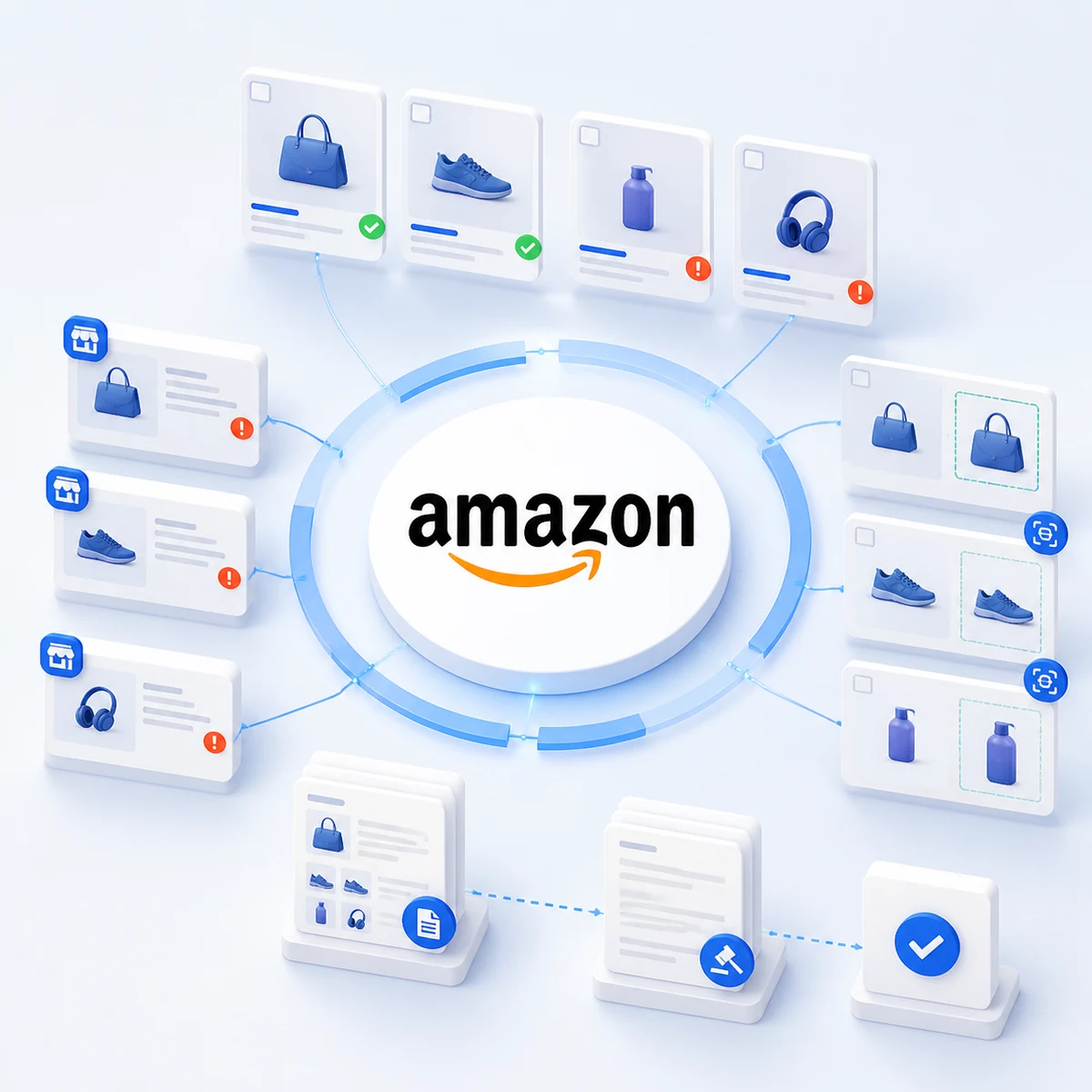
The scale of Amazon counterfeiting
Amazon’s global marketplace gives counterfeiters many routes to reach customers. A fake listing can reuse product images, alter brand wording and undercut an authorised seller before the brand finds it.
Truviss analyses more than 500 data points per listing, including images, price, seller history, text and metadata.
For brands, the damage goes beyond lost sales. Counterfeit products generate negative reviews under the brand’s name, erode customer trust, and can trigger Amazon’s own policy violations against the brand’s account. A single wave of fake listings can undo months of reputation building.
How counterfeit listings appear on Amazon
Understanding how counterfeiters operate is the first step to stopping them. Amazon’s open marketplace model, combined with Fulfilment by Amazon (FBA), creates several attack vectors.
How to remove counterfeit listings from Amazon
Amazon provides several enforcement mechanisms for brand owners. Understanding each one, and when to use it, is essential for effective counterfeit removal.
Enrol in Amazon Brand Registry
Amazon Brand Registry gives eligible rights owners access to search, reporting and enforcement tools. Eligibility depends on the trademark status and country supported by Amazon.
Use Report a Violation for individual listings
Brand Registry’s Report a Violation tool lets enrolled rights owners search for suspected infringements and submit evidence. Amazon reviews each report under its current policies and does not guarantee a fixed response time.
Enable Project Zero for automated removals
Project Zero gives trusted brands the ability to remove counterfeit listings themselves, without waiting for Amazon’s review. Eligibility is based on your track record of accurate counterfeit reports. Brands with a historically high accuracy rate gain access to self-service removal tools.
File through APEX for patent infringement
Patent disputes follow Amazon’s current patent-reporting process and require evidence suited to the relevant patent right. Requirements vary by claim and marketplace.
Document evidence for legal escalation
When platform tools are not enough, brands may pursue legal action. Amazon’s enforcement team cooperates with court orders, but brands need a documented evidence trail: timestamps, screenshots, seller identities and purchase records. Maintaining this evidence from the first detection strengthens any legal case.
Key point: Counterfeiters can relist after a takedown. Periodic manual checks create detection gaps, so ongoing monitoring is needed.
Evidence requirements for Amazon takedowns
Amazon rejects vague or incomplete reports. A successful takedown includes:
- Specific ASIN or listing URL identifying the infringing product
- Proof of trademark ownership (Brand Registry confirmation or trademark registration number)
- Visual evidence comparing the counterfeit product to the genuine product (packaging, labelling, quality differences)
- Seller identification including seller name, storefront URL and any known connections to previous infringers
- Price analysis showing pricing inconsistent with authorised distribution
- Purchase samples where available, with photographs of the counterfeit product
Complete, well-organised evidence gives the platform clearer information to assess. Requirements and outcomes depend on the platform’s current policy.
Why manual counterfeit removal fails at scale
Most brands start by having a team member manually search Amazon for counterfeits and file reports. This works when there are a handful of infringing listings. It breaks down when the problem grows.
| Challenge | What happens |
|---|---|
| Volume | A single brand can face hundreds of counterfeit listings across Amazon’s global marketplaces. Manually searching, evaluating and filing reports for each one is a full-time job that scales poorly. |
| Speed | Counterfeiters relist after a takedown. A weekly manual sweep means fakes may remain live before detection, and the cycle repeats after removal. |
| Accuracy | Inaccurate reports can weaken enforcement workflows. SKU-level verification and human review help reduce false positives. |
| Coverage | Most brands monitor only their home marketplace (Amazon.com or Amazon.in). Counterfeiters exploit this by listing on secondary marketplaces where enforcement is weaker. |
| Evidence | Collecting screenshots, timestamps and seller data for every listing is tedious and error-prone. Weak evidence packages lead to rejected reports. |
How Truviss automates Amazon counterfeit removal
Truviss replaces manual monitoring with continuous, automated surveillance and enforcement across Amazon’s global marketplace network.
Automated detection across every Amazon marketplace
Truviss scans Amazon listings 24/7, analysing 500+ data points per listing: images, pricing, seller history, product text and metadata. The system identifies suspected counterfeits by cross-referencing these signals against your brand’s actual product catalogue at SKU level. This catches fakes that keyword-only tools miss, including listings with stolen images but altered text, or slight packaging variations designed to evade simple matching.
Evidence-led enforcement workflows
Truviss prepares evidence-led takedown workflows for marketplace enforcement and tracks actions, screenshots and seller data in one audit trail. Eligible brands can continue using Amazon tools such as Brand Registry and Project Zero within Amazon’s own access rules.
Repeat offender tracking
When a seller account is removed, the same operator may return under another identity. Truviss compares seller details and listing patterns to help teams identify repeat offenders and maintain a stronger evidence trail.
Multi-marketplace coverage
Truviss monitors more than 150 online marketplaces, including Amazon and regional marketplace sites, from one dashboard. This helps brands find listings outside their usual manual checks.
Frequently asked questions
Amazon does not guarantee a fixed review time. Project Zero lets eligible brands remove confirmed counterfeit listings through Amazon’s self-service tool. Truviss reduces delay before filing by automating detection, verification and evidence preparation.
Brand Registry is Amazon’s programme for brand owners with active registered trademarks. It provides access to search and reporting tools, storefront customisation, and enforcement features that unregistered brands do not have. It is the prerequisite for Project Zero and most counterfeit reporting workflows.
Project Zero combines Amazon’s automated protections with a self-service counterfeit-removal tool for eligible Brand Registry users. Access depends on Amazon’s current eligibility and accuracy requirements.
Yes. Counterfeiters frequently relist under new seller accounts after a takedown. This is why ongoing monitoring is essential. Truviss tracks repeat offenders across accounts, identifying patterns that indicate the same operator behind multiple listings, which speeds up subsequent enforcement actions.
Truviss analyses listing images, pricing, seller history, text and metadata against the brand’s catalogue. It supports evidence-led marketplace reporting workflows and tracks enforcement activity.
Useful evidence can include the ASIN or listing URL, rights-ownership records, visual comparisons and seller details. Truviss stores relevant evidence and enforcement activity in a unified audit trail.
Truviss matches suspected counterfeits against your actual product catalogue at SKU level, analysing images, pricing, seller history and product data together. This multi-signal approach targets real infringements rather than legitimate third-party sellers. Human review is available for edge cases before any action is taken.
Truviss monitors more than 150 online marketplaces, including Amazon and regional marketplace sites, from one dashboard.
 Flipkart
 Meesho
 Alibaba
 Instagram
 Facebook
 YouTube
 X / Twitter
Stop chasing counterfeit listings manually
Truviss monitors Amazon 24/7, detects counterfeits at SKU level and supports automated takedown workflows and tracks evidence.
Book a Demo