How to remove counterfeit listings from Shopee
Counterfeit products on Shopee undercut genuine sellers, divert revenue and damage customer trust across every market Shopee operates in. This guide explains how fakes appear, how Shopee’s Brand IP Portal works and why periodic manual checks leave gaps.
See how Truviss can help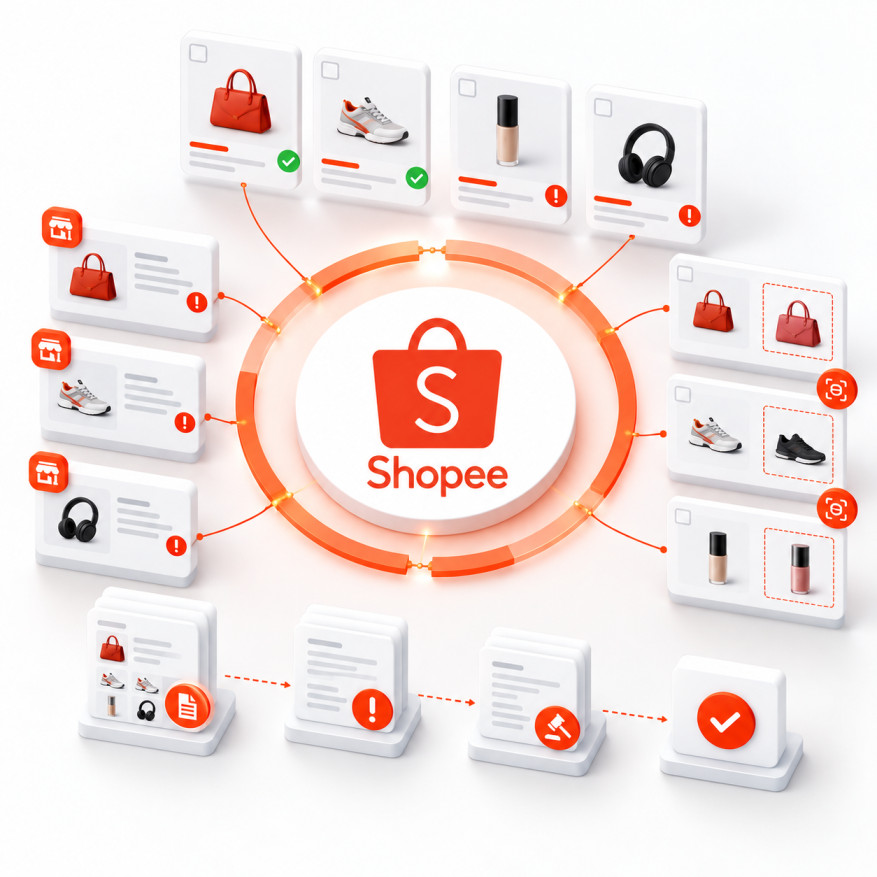
The scale of Shopee counterfeiting
Shopee runs separate storefronts across Indonesia, Malaysia, Thailand, Vietnam, the Philippines, Singapore and Taiwan. A counterfeit listing removed in one market can reappear, unchanged, in another. Fake listings reuse genuine product photos, alter branding just enough to dodge simple keyword matches, and undercut authorised sellers before anyone notices.
Truviss analyses more than 500 data points per listing, including images, price, seller history, text and metadata.
For brands, the damage goes beyond lost sales. Counterfeits on Shopee generate negative reviews against the genuine brand, erode buyer trust in legitimate listings, and can draw policy scrutiny toward authentic seller accounts caught in the same search results.
How counterfeit listings appear on Shopee
Understanding how counterfeiters operate is the first step to stopping them. Shopee’s open marketplace model, spanning seven country storefronts, creates several attack vectors.
How to remove counterfeit listings from Shopee
Shopee provides several enforcement mechanisms for brand owners. Understanding each one, and when to use it, is essential for effective counterfeit removal.
Register on the Shopee Brand IP Portal
Brand owners submit trademark documentation to validate their rights with Shopee. Authorised agents and law firms can register and file on a brand’s behalf.
Report infringements individually or in bulk
The portal lets registered brands search for suspected listings and submit evidence per case, rather than emailing Shopee’s support team directly.
Track case status in the portal
Submitted cases can be tracked through to resolution, though enforcement decisions are made locally by each market’s trust and safety team, so timing and outcomes vary.
Use bulk reporting for scale
Brands facing high volumes of infringing listings can submit cases in bulk rather than one at a time, cutting down the manual load of repeat filing.
Document evidence for legal escalation
When portal reports are not enough, brands need a timestamped evidence trail: screenshots, seller identities and purchase records. Maintaining this evidence from the first detection strengthens any legal case.
Key point: Shopee’s enforcement decisions are made market by market. A takedown in one country storefront does not remove the same listing elsewhere, so ongoing monitoring across every Shopee market is needed.
Evidence requirements for Shopee takedowns
Shopee rejects vague or incomplete reports. A well-prepared takedown request includes:
- Listing ID or URL identifying the infringing product
- Proof of trademark ownership (Brand IP Portal confirmation or trademark registration number)
- Visual evidence comparing the counterfeit to the genuine product (packaging, labelling, quality differences)
- Store identification including store name, storefront URL and any known links to previous infringers
- Price analysis showing pricing inconsistent with authorised distribution
- Purchase samples where available, with photographs of the counterfeit product
Complete, well-organised evidence gives the platform’s review team clearer grounds to act. Requirements and outcomes depend on the platform’s current policy.
Why manual counterfeit removal fails at scale
Most brands start by having a team member manually search Shopee for counterfeits and file reports. This works when there are a handful of infringing listings. It breaks down when the problem grows.
| Challenge | What happens |
|---|---|
| Volume | A single brand can face hundreds of counterfeit listings spread across Shopee’s seven-plus country storefronts. Searching, evaluating and filing a case for each one manually is a full-time job that scales poorly. |
| Speed | Counterfeiters relist within days of a takedown under a new store name. A weekly manual sweep leaves fakes live for stretches at a time, and the cycle repeats after every removal. |
| Accuracy | Inaccurate case submissions slow the Brand IP Portal’s review queue. SKU-level verification and human review help reduce false positives. |
| Coverage | Most brands monitor only their home Shopee market. Counterfeiters exploit this by listing on the storefronts a brand checks least often. |
| Evidence | Collecting screenshots, timestamps and store data for every case is tedious and error-prone. Weak evidence packages slow down local review teams. |
How Truviss automates Shopee counterfeit removal
Truviss replaces manual monitoring with continuous, automated surveillance and enforcement across Shopee’s marketplace network.
Automated detection across every Shopee marketplace
Truviss scans Shopee listings 24/7 across every country storefront, analysing 500+ data points per listing: images, pricing, seller history, product text and metadata. Suspected counterfeits are cross-referenced against your brand’s actual product catalogue at SKU level, catching fakes that keyword-only tools miss, including stolen images paired with altered text or minor packaging variations.
Evidence-led enforcement workflows
Truviss prepares evidence-led case files formatted for Shopee’s Brand IP Portal and tracks every action, screenshot and store record in one audit trail. Brands keep using the Brand IP Portal directly, within Shopee’s own access rules, with far less manual evidence-gathering beforehand.
Repeat offender tracking
When a store is suspended, the same operator often returns under a new store name. Truviss compares store details and listing patterns to help teams identify repeat offenders across Shopee’s markets and build a stronger evidence trail.
Multi-marketplace coverage
Truviss monitors more than 150 online marketplaces, including every Shopee country storefront and other Southeast Asian marketplaces, from one dashboard.
Frequently asked questions
Shopee reviews Brand IP Portal cases locally in each market, so response times vary by country and are not fixed. Truviss reduces the delay before filing by automating detection, verification and evidence preparation, so a case reaches the portal already substantiated.
The Brand IP Portal is Shopee’s programme for registered rights owners to submit trademark documentation, report infringing listings and track case status. It is the standard route for reporting counterfeits at any meaningful scale, and authorised agents can register and file on a brand’s behalf.
No. Shopee’s country storefronts are reviewed independently by local trust and safety teams. A brand needs to monitor and report separately in each market where it has exposure.
Yes. A suspended store commonly reopens under a new name and relists within days. Truviss tracks store identities and listing patterns across accounts, flagging repeat offenders so subsequent enforcement moves faster.
Truviss analyses listing images, pricing, seller history, text and metadata against a brand’s own catalogue, prepares evidence-led case files formatted for the Brand IP Portal, and tracks enforcement activity in one place.
Truviss matches suspected counterfeits against a brand’s actual product catalogue at SKU level, weighing images, price, seller history and product data together. Human review is available for edge cases before any case is filed.
Yes. Truviss monitors more than 150 online marketplaces, including every Shopee country storefront alongside other regional and global marketplaces, from a single dashboard.
Platform-specific counterfeit removal guides






Stop chasing counterfeit Shopee listings manually
Truviss monitors every Shopee storefront 24/7, detects counterfeits at SKU level, and supports evidence-led takedown workflows with a full audit trail.