Truviss’s App Scanner monitors iOS and Android app stores for rogue and cloned apps trading on your brand.
Book a demo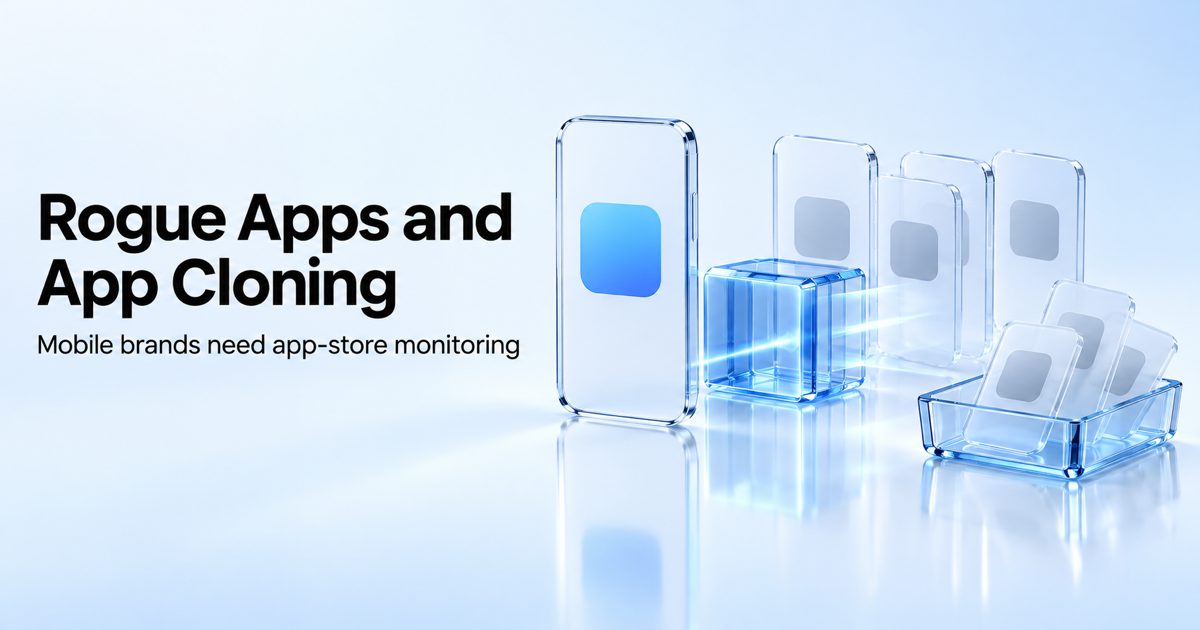
- A rogue app impersonates a real brand’s app to trick users into installing it; a cloned app goes further, copying the interface closely enough to pass for the genuine one.
- Both exploit the same gap: app store review checks for malware and policy violations, not whether an app is genuinely authorised by the brand it claims to represent.
- The cost isn’t just a lost download, it’s stolen credentials, fraudulent in-app purchases and reviews that land on the real brand’s reputation.
- Detection has to run continuously across both iOS and Android, since a takedown on one store does nothing to remove the same clone from the other.
What a rogue or cloned app actually is
A rogue app is any app that misrepresents its relationship to a brand it isn’t actually authorised to use, often by copying a brand’s name, icon or description closely enough to be mistaken for the real thing in a quick app-store search. App cloning is the more deliberate version of this: the interface, flow and even the functionality of a genuine app rebuilt and republished under a different developer account, sometimes with malicious code added, sometimes just to capture ad revenue or user data the original app never consented to sharing.
Both prey on the same moment, a user searching an app store by brand name, scanning results quickly, and picking whichever result looks close enough to what they expected.
How app cloning works
Cloning a mobile app doesn’t require access to the original source code. A cloned app is usually rebuilt from scratch by studying the real app’s public interface, icon, screenshots and store listing, then republishing something visually near-identical under a different account. Decompiling and repackaging an app’s public APK is also common on Android, since the platform doesn’t require the same closed review process app stores use for distribution.
Once published, a rogue or cloned app relies on the same discovery mechanics as any legitimate app, search results, category browsing and sometimes even paid app-store ads, to reach users who were actually looking for the genuine brand.

Why app stores are harder to police than they look
App store review processes are built to catch malware, policy violations and broken functionality, not to verify that every app claiming a connection to a brand actually has one. A rogue app that behaves properly, doesn’t request suspicious permissions, and doesn’t get flagged for malware can pass automated and even manual review while still being entirely unauthorised.
This gets harder across platforms. iOS and Android have separate review processes and separate reporting mechanisms, so a rogue app removed from one store has no bearing on an identical clone still live on the other. A brand monitoring only one platform is, in practice, monitoring half its actual exposure.
The cost of a cloned app in the wild
The immediate risk is to the user who installs the fake, a cloned app requesting more permissions than the real one, serving intrusive ads, or in more serious cases harvesting login credentials or payment details under a familiar-looking interface. But the reputational cost lands on the real brand regardless of who built the clone. A user who has a bad experience with a rogue app, or worse, has data stolen through one, will very often leave a negative review and blame the genuine brand, since from their perspective that’s whose app they thought they installed.
App store reviews are also a ranking signal. A cluster of one-star reviews left against a rogue app can, in a user’s memory, attach itself to the real brand’s own app if the two were ever confused, even after the fake is eventually removed.
How detection and takedown actually work
Effective monitoring scans both iOS and Android continuously, comparing newly published apps against a brand’s known assets, name, icon, screenshots and description, to flag matches that weren’t published by the brand’s own verified developer account. A verified rogue or cloned app is then reported through each store’s own brand-infringement or intellectual property reporting process, since neither Apple nor Google offers a single shared takedown mechanism across both platforms.
See how Truviss’s App Scanner flags rogue and cloned apps across iOS and Android before they reach your customers.
Explore App ScannerEvidence matters here as much as it does for any other takedown, screenshots, publish dates and permission requests logged at the point of detection make a reporting case far stronger than a vague complaint filed after the fact.

Getting started
If a brand has a genuine mobile app, or even a strong enough name recognition that a fake would be worth building, app store monitoring is worth setting up before a rogue app appears, not after the first user complaint arrives. Pair it with the same continuous approach used for other forms of online brand abuse, since a brand facing app cloning is very often facing counterfeit listings or impersonator accounts on other channels at the same time.
Frequently asked questions
A rogue app is any unauthorised app trading on a brand’s name or identity, which can be a fairly rough imitation. A cloned app is a more precise copy of a genuine app’s interface and functionality, built to be mistaken for the original at a glance.
Not reliably. App store review checks for malware and policy compliance, not brand authorisation, so a well-behaved clone can pass review while still being entirely unauthorised.
No. Apple and Google run entirely separate review and takedown processes, so a rogue app removed from one platform can remain live on the other until it’s reported and actioned there separately.
No. A well-known brand with no app of its own can still be impersonated by a rogue app trading purely on name recognition, sometimes to serve ads or harvest data from users who assume the brand has an official app when it doesn’t.

Mithileshkumar leads growth at Truviss, working every day to make sure the brands losing the most to counterfeits, fraud and digital impersonation are the ones who find out about a fix first. He’s spent his career believing that good marketing isn’t about noise, it’s about showing up right when someone needs the answer. Off the clock, he’s usually chasing the same instinct in something entirely unrelated to work.