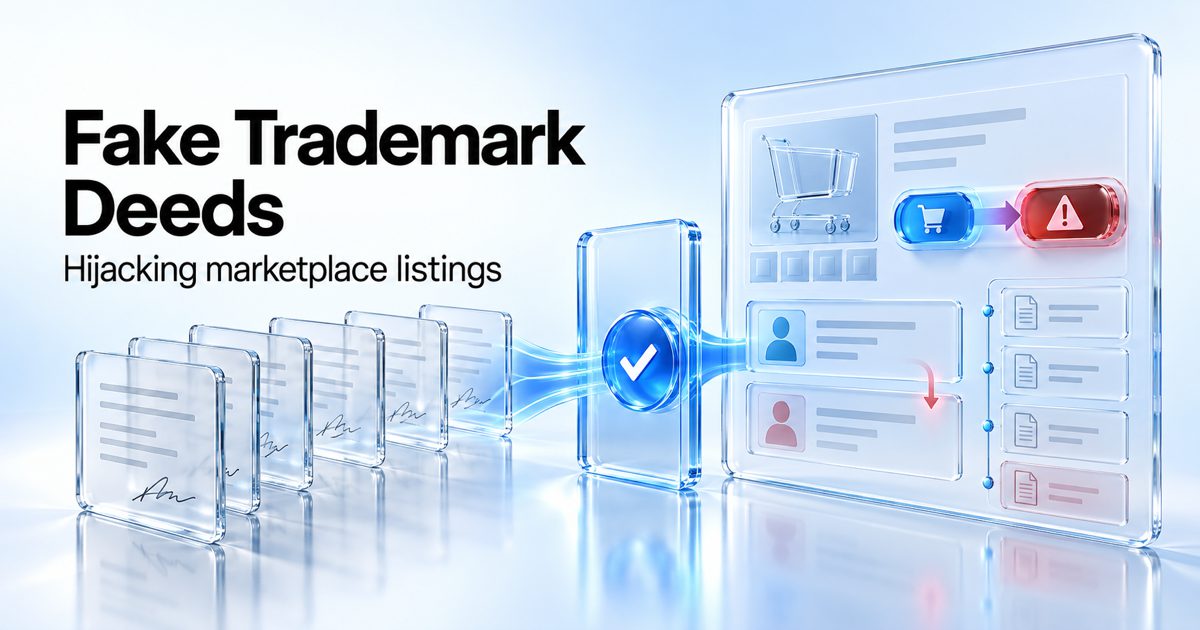
Truviss’s Marketplace Scanner tracks Buy Box and seller-identity changes on your own listings, catching an ownership hijack before it costs you your reviews and sales history.
Book a demo- Counterfeiters are forging trademark registration certificates and assignment deeds to convince marketplaces they own a brand, then taking over the real seller’s listing.
- Standard counterfeit-detection tooling (image, price, duplicate-listing checks) doesn’t catch this: the product and price stay the same, only who controls the listing changes.
- The fix is monitoring listing ownership and seller-identity changes directly, not adding another layer of counterfeit-image detection.
- Speed matters once it happens: reviews and sales history built over years keep accruing to the hijacker until the listing is reclaimed.
A seller on Amazon spends years building a listing: real product, real reviews, real sales rank. Then one day the Buy Box quietly changes hands. Not because a shopper preferred someone else’s price. Because someone else submitted a trademark assignment deed claiming they, not the original seller, own the brand behind that listing, and the marketplace’s verification process accepted it.
This is happening on marketplaces right now, and it isn’t a counterfeit-detection problem in the sense most brand-protection advice assumes. It’s a document-fraud problem aimed squarely at the marketplace’s own trust process, and it’s catching sellers who did everything else right.
How the forgery actually works
Counterfeiters used to need a convincing fake product. Increasingly, they don’t bother faking the product at all, they fake the paperwork that proves who owns the brand behind it. Business Standard’s reporting on this (15 July 2026, “Fake signatures, fake lawyers: Counterfeiters outsmart online marketplaces”) documented forged trademark registration certificates, fabricated assignment deeds, and fake legal letterhead submitted to convince a marketplace that the submitter, not the actual brand owner, holds the rights.
Once that claim is accepted, the marketplace treats the forger as the legitimate rights-holder. That’s the part that makes this different from a normal counterfeit listing: the marketplace isn’t being fooled by a bad product, it’s being fooled by paperwork that looks exactly like the real documentation it’s designed to accept. A trademark certificate is a trademark certificate to an automated verification queue processing thousands of submissions; it doesn’t inherently know that this particular one is fabricated. From there, the forger can attach their own offer to the real seller’s existing listing (a Buy Box takeover, riding on reviews and sales history they never earned) or, in more aggressive cases, file a false infringement complaint against the real seller using the fabricated ownership claim, getting the genuine listing suspended entirely.
Why standard counterfeit-detection tooling misses this
The existing brand-protection playbook, and every major vendor’s published guide to it, is built around one assumption: the brand owner is the one filing evidence to get someone else’s bad listing removed. Red Points, BrandShield, Corsearch and mFilterIt all publish detailed guides on exactly that process: identify the infringement type, gather proof of ownership, submit it to the platform, wait for a response. All of it assumes your ownership status isn’t in dispute.
None of it covers the inverted case: a brand owner losing control of their own listing because somebody else’s forged paperwork got accepted first. If your detection tooling is watching for counterfeit images, suspicious pricing, or duplicate listings, none of those signals fire here. The product photos are real. The price is normal. The listing itself hasn’t changed at all except who controls it. This is a gap in what “counterfeit detection” usually means, not a failure of any one vendor’s execution of it.

What actually catches it: watching who controls the listing, not just what’s on it
If the attack targets ownership and identity rather than product or price, the defence has to watch the same thing: who controls a listing, and when that control changes. That means monitoring Buy Box reassignment on your own listings, tracking seller-identity changes behind a product page that previously belonged to you, and treating an unexplained ownership or seller-ID shift as a signal worth investigating immediately, not something that surfaces weeks later in a routine audit.
This is a different job from scanning marketplaces for lookalike products or counterfeit images, and it’s the specific gap Truviss’s Marketplace Scanner is built to close: continuous marketplace monitoring of listing and seller-identity signals, not a one-time image sweep. A related but distinct problem worth knowing about too: AI-generated fake product listings built from synthetic photos rather than forged paperwork, covered separately since the mechanism and the fix both differ from what’s described here.
See how Truviss’s Marketplace Scanner tracks Buy Box and seller-identity changes on your own listings.
Explore Marketplace Scanner
What to do if it’s already happened
Speed matters more than thoroughness here, because every day the hijack goes unresolved, the reviews and sales history a legitimate seller built over years keep accruing to someone who took the listing by forging a document, not by earning it.
Gather what actually proves prior ownership: the original trademark registration in your name, dated records of when you first listed the product, and the specific date the Buy Box or listing control changed hands. Escalate directly to the marketplace’s brand-registry or IP-enforcement team rather than a general seller-support queue; general support often isn’t equipped to adjudicate a competing ownership claim and will default to whichever document was submitted first. If the marketplace’s takedown process stalls because it’s treating this as a dispute between two rights-holders rather than a fraud case, be explicit that the submitted documents are forged, not merely contested, and provide whatever evidence supports that (verifiable trademark office records, for instance) as directly as possible.
The uncomfortable part of this is that the marketplace’s own verification step, the thing meant to protect legitimate sellers, is the exact mechanism being exploited. That’s not a reason to stop relying on platform enforcement, but it is a reason not to treat “the marketplace verifies ownership” as a defence on its own. It’s a defence that fails silently, and the only reliable way to catch that failure is watching your own listings for exactly the kind of ownership change that shouldn’t be able to happen without your knowledge.
Related reading
 Marketplace Protection
Generative AI lets one seller mass-produce fake listings. See how detection AI is catching up.
 Marketplace Protection
A complete guide to protecting intellectual property in e-commerce, from infringement types to takedowns.

Mithileshkumar leads growth at Truviss, working every day to make sure the brands losing the most to counterfeits, fraud and digital impersonation are the ones who find out about a fix first. He’s spent his career believing that good marketing isn’t about noise, it’s about showing up right when someone needs the answer. Off the clock, he’s usually chasing the same instinct in something entirely unrelated to work.