How to remove counterfeit listings from Tokopedia
Counterfeit products on Tokopedia undercut genuine sellers and sometimes slip past the keyword and price filters designed to catch them. This guide explains how fakes appear, how Tokopedia’s IP Protection Portal and detection engine work, and why brands still need their own monitoring.
See how Truviss can help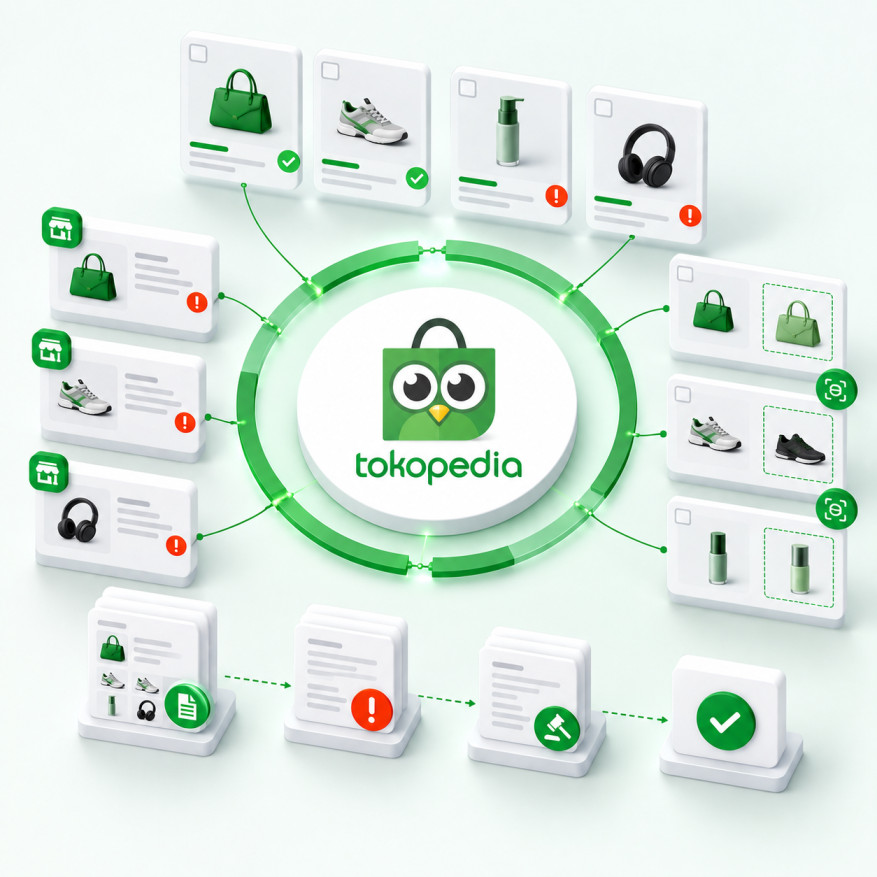
The scale of Tokopedia counterfeiting
Tokopedia runs its own counterfeit detection engine, combining product keywords, brand terms and price filters to find and remove suspected fakes automatically, and it has reported handling tens of thousands of takedowns a week. Even so, listings engineered to sit just outside those filters, near-genuine pricing, altered keywords, still get through.
Truviss analyses more than 500 data points per listing, including images, price, seller history, text and metadata.
For brands, the damage goes beyond lost sales. A fake listing that survives Tokopedia’s own filters can sit live generating negative reviews against the genuine brand until a rights holder reports it directly.
How counterfeit listings appear on Tokopedia
Understanding how counterfeiters operate is the first step to stopping them. Tokopedia’s own detection engine blocks most fakes, but several attack vectors are built specifically to evade it.
How to remove counterfeit listings from Tokopedia
Tokopedia provides several enforcement mechanisms for brand owners, on top of its own automated filters. Understanding each one, and when to use it, is essential for effective counterfeit removal.
Register on Tokopedia’s IP Protection Portal
The portal gives rights holders a dedicated account, faster registration of legal documents, and a direct channel for reporting infringing listings.
Report listings the detection engine missed
Tokopedia’s own engine contributes the majority of takedowns automatically, but a rights holder still needs to report listings engineered to evade keyword and price filters.
Track enforcement through the penalty scoring system
Repeat or serious violations count against a seller’s score, leading to listing restriction, suspension or permanent removal, evaluated from a seller’s first listing onward.
Join the Brand Alliance Programme
Qualified rights holders can join Tokopedia’s Brand Alliance Programme for closer, multi-party cooperation on enforcement beyond individual case reporting.
Maintain a documented evidence trail
Tokopedia has reported resolving brand IP cases in under 24 hours on average, but a brand still needs timestamped evidence, screenshots and purchase records for listings its own monitoring catches first.
Key point: Tokopedia’s detection engine already removes a large share of counterfeits automatically. The gap Truviss closes is the smaller, harder share: listings engineered specifically to evade keyword and price filters.
Evidence requirements for Tokopedia takedowns
Tokopedia rejects vague or incomplete reports. A well-prepared takedown request includes:
- Listing URL identifying the infringing product
- Proof of trademark ownership or registration, for IP Protection Portal onboarding
- Visual evidence comparing the counterfeit to the genuine product (packaging, labelling, quality differences)
- Store identification including store name, storefront URL and any known links to previous infringers
- Price analysis showing pricing inconsistent with authorised distribution
- Purchase samples where available, with photographs of the counterfeit product
Complete, well-organised evidence gives the platform’s review team clearer grounds to act. Requirements and outcomes depend on the platform’s current policy.
Why manual counterfeit removal fails at scale
Most brands start by having a team member manually search Tokopedia for counterfeits and file reports. This works when there are a handful of infringing listings. It breaks down when the problem grows.
| Challenge | What happens |
|---|---|
| Volume | Even with Tokopedia’s own detection engine running, a large brand catalogue can still generate more borderline listings each week than a small team can manually verify. |
| Speed | Tokopedia’s reported under-24-hour response applies once a case is reported. Listings that evade the automated filters can sit live for however long it takes a human to spot them. |
| Accuracy | Reporting a listing that turns out to be a genuine reseller wastes the portal’s review time and can strain a brand’s standing with its own distribution partners. |
| Coverage | Tokopedia’s detection engine is tuned to Tokopedia itself. Brands selling on other marketplaces still need separate monitoring. |
| Evidence | Assembling screenshots, listing URLs and rights documentation for every borderline case is tedious, and the portal’s review moves faster with a complete package upfront. |
How Truviss automates Tokopedia counterfeit removal
Truviss replaces manual monitoring with continuous, automated surveillance and enforcement, complementing Tokopedia’s own detection engine.
Automated detection across Tokopedia and beyond
Truviss scans Tokopedia listings 24/7, analysing 500+ data points per listing: images, pricing, seller history, product text and metadata. Suspected counterfeits are cross-referenced against a brand’s actual catalogue at SKU level, catching the keyword-evasion and price-evasion tactics designed to slip past Tokopedia’s own filters.
Evidence-led enforcement workflows
Truviss prepares evidence-led case files formatted for Tokopedia’s IP Protection Portal and tracks every action, screenshot and store record in one audit trail, complementing Tokopedia’s own detection engine rather than duplicating it.
Repeat offender tracking
When a store’s penalty score forces a shutdown, the same operator often reopens under a new name with a clean score. Truviss compares store details and listing patterns to flag repeat offenders regardless of the store name attached.
Multi-marketplace coverage
Truviss monitors more than 150 online marketplaces, including Tokopedia and other Indonesian and regional marketplaces, from one dashboard.
Frequently asked questions
Yes. Tokopedia’s own detection engine combines keyword, brand-term and price-filter matching to find and remove a large share of infringing listings automatically. Listings engineered to sit just outside those filters still need a rights holder to report them.
It is Tokopedia’s reporting channel for rights holders, offering a dedicated account, faster registration of legal documents, and a direct path to flag listings the automated detection engine has not caught.
Tokopedia has reported reducing its average response time on brand IP cases to under 24 hours. That applies once a case is reported and does not cover listings still awaiting detection.
It is Tokopedia’s seller-enforcement mechanism: violations count against a seller’s score from their first listing onward, and sellers who accumulate enough violations face listing restriction, suspension or permanent removal.
It is a Tokopedia programme for qualified rights holders to cooperate more closely with the platform and other members on enforcement, beyond filing individual reports through the IP Protection Portal.
Yes. Slightly misspelled brand names, near-genuine pricing and reworded descriptions are common ways listings evade keyword and price-filter matching. Truviss’s SKU-level, multi-signal matching is built to catch exactly this kind of evasion.
Yes. Truviss monitors more than 150 online marketplaces, including Tokopedia alongside other Indonesian and regional marketplaces, from a single dashboard.
Platform-specific counterfeit removal guides






Catch what Tokopedia’s filters don’t
Truviss monitors Tokopedia 24/7, detects counterfeits at SKU level, and supports evidence-led takedown workflows alongside Tokopedia’s own detection engine and IP Protection Portal.