Copyright and Related Rights
Who owns a creative work, what the owner can do with it, and how to show it.
Start the lesson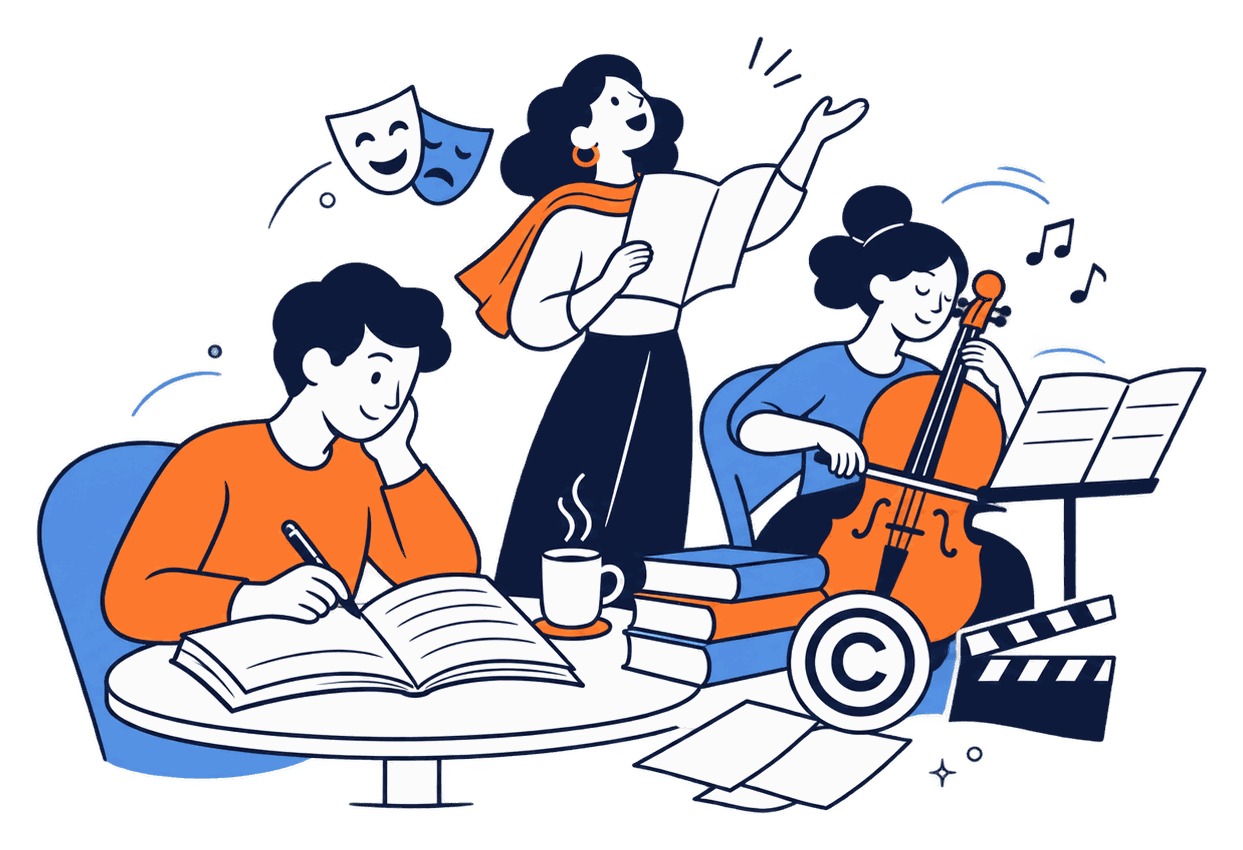
1Overview
Copyright is an exclusive legal right given to the author of the original literary or artistic work. The copyright law includes protection of works such as published papers/books, media, paintings, artwork, plays, movies, software, digital content, etc. To qualify for protection under copyright law, the work must be original.
- What copyright is and why it matters for creators and businesses
- The types of works protected under copyright law
- The concepts of economic and moral rights
- Related rights and their importance in modern media
- How registration and copyright notices work
- Understanding fair use and its implications
2What is copyright
The law grants an author/creator a bundle of exclusive rights for a limited period. It enables the author to control the use of their work in multiple forms. When the creator wants to sell their work for adaptation from ‘book into play, play into movie or vice-versa’. It shall be allowed only by securing permission from the author against a decided consideration.
For example, the story of the ‘Harry Potter’ book was adapted into a movie and now as a play, only based on the permission to use procured by its author, J.K. Rowling.
Examples of copyrights
- Literary Work- eg, Poetry, book, speech, magazine, etc
- Musical Work- eg, song, composition, etc.
- Drama Works- eg, play, mime, live show
- Artistic Works- eg, paintings, drawings, architecture, blueprints, laser/commercial print, labels, etc.
- Photographic works- eg, photos
- Motion Pictures- eg, movies, advertisements, etc.
- Computer programs, software, and databases
- Multimedia products- eg, combined work of visual image/motion picture with text or music.
A copyright grants two major kinds of rights: i. Economic rights and ii. Moral Rights
| Economic Rights | Moral Rights | |
|---|---|---|
| Meaning | It is the creator’s ability to earn from the copyrighted work. | It is a creator’s integrity (authorship/paternity) and reputation in the copyrighted work. |
| Limitation of Use | These economic transactions can grant the transfer of title to use the work. It permits reproducing/renting/selling/assigning/adapting or other use of the copyrighted work against a sum of value | It involves paternity/integrity rights, which cannot be transferred. The title of authorship is retained by the original author/creator. |
| Example | The publishing rights over a copyrighted work can be transferred from the creator to another person for commercial purposes. | A new version of 'The Ramayana' story will have to give credit to the original writer/author of the book. |
- Can be sold, rented, licensed or assigned
- Example: publishing rights moved from creator to a publisher
- Cannot be transferred
- Example: a new version of The Ramayana must credit the original author
3Concept of related rights
The rights conferred to ‘related’ or ‘neighbouring’ roles to the copyright. These are rights given to a limited set/category of people/organisations for their role in multiplying the communication of the work to the public or increasing the economic benefit of the work.
There are 3 major kinds of related rights: 1. Right to performers, 2. Right to producers of music recording 3. Right to broadcasting organisations on different platforms- television, radio, OTT, podcast, etc.
Rights of Performers: Example: Lin-Manuel Miranda wrote the musical Hamilton (Copyright). The actors, singers, and musicians who perform it live on Broadway have Performers' Rights protecting their specific live performance from being recorded and sold without consent.
Rights of Producers of Sound Recordings: Example: Sony Music Entertainment invests money to rent a studio, hire sound engineers, and manufacture/distribute a music album. Sony holds the phonogram producer rights to that specific master audio recording.
Rights of Broadcasting Organisations: Example: Netflix or ESPN paying for the rights to broadcast a live sports match or stream a series. No outside party can screen or re-broadcast that stream onto another platform without paying them licensing fees
4Registration and protection of copyright work
The Berne Convention is the international treaty for the protection of literary and artistic works. It was the agreement that bound all the signing countries to implement the copyright law.
There is no compulsion to register at the government offices for copyright work. It can be published with a ‘copyright notice’. The work will be automatically eligible for protection in all the countries that have signed the Berne Convention.
The copyright registration is universal in nature, and protection remains territorial in nature.
Period of protection
The copyright protection is granted as per the timeline below.
The duration of protection granted to related rights is for a shorter term. It is calculated from the decided/fixed date or when the performance took place to 20 to 50 years, as per different country regulations. For example, India grants 25 years of protection, whereas European countries grant 50 years of protection.
The following are not protected by copyright:
- Ideas: an idea alone is not protected, though an invention built on it may be patented
- Facts- these are public domain details
- Articles/literature in the Public domain- these are public domain details
- Names, devices and short phrases: these may be protected as trademarks
- Government official works, such as emblems/statutes/judicial opinions, etc, are public domain details.
Registration process and copyright deed of assignment (CDOA)
Copyrights provide worldwide protection and are independent of the official procedures. However, it is suggested that the authors register under the national procedure to create an official record.
Both published and unpublished work can be applied for registration. It can take a minimum of 6 months to 2 years for completion of the registration procedure. The registration procedure is considered from the application to the grant stage.
For commercial documentation and evidence, in the absence of registration, alternatively, companies/organisations can create a legal agreement- Copyright deed of assignment (CDOA). The CDOA is an agreement to be printed on legal stamp paper. It is to create a legal record between the creator and user, allowing the assignment/right to use the copyrighted work commercially. This shall be useful to legally enforce the rights over the work in case of infringement.
5Copyright notice
A copyright notice is a prescribed form informing users of the underlying claim to ownership of copyright in the published/presented work.
A copyright notice mainly consists of the following:
- The word ‘Copyright’ or symbol ‘©️’
- The year in which the work was first made/published/presented
- The name of the copyright owner (It can be the same as the author of the work or the owner, who is given rights over the work)
The claim “All rights reserved”
Example: A book written and owned by Mr XYZ is published in the year 2020; its copyright notice shall be as mentioned below
- ©2020 XYZ. All Rights Reserved.
- Copyright 2020 XYZ. All Rights Reserved.
A copyright notice can be mentioned in a written, typed, stamped or painted form along with the work. There is no set/formal procedure to add the notice to your work.
It helps the user to realise the year in which the work was made/published, along with the claim of the author/owner. There are no extra expenses/charges involved in adding the notice. It is not compulsory to add the notice to the work. Yet, it is strongly recommended and advisable to place the notice along with the copyrighted work.
6Concept of fair use
Fair use is a doctrine judicially referring to the use of copyrighted work without infringing upon the same. It is an exception to the copyright law. It means copyrighted work can be used in a new work, in a limited way, without procuring express permission from the creator. It is an established way of providing limitations on using available copyrighted work in a manner that shall not amount to loss of any rights (both economic and moral) to the creator.
Testing factors to check the fair use:
- The purpose of the used copyright material
- The quantity or substance of the work used
- New work must be predominantly original
The commercial aspect is unaffected by the copyrighted work
For example:
- The new work should be either a critique, an education or a news article
7Do's and don'ts
Do
- Copyright begins on creation; use a copyright notice when using your work in public.
- Be aware of the moral rights of copyright for your own work as well as others
- Registration is not mandatory, but suggested to either register/create a CDOA for legal records
- Maintain documented agreements to protect related/ neighbouring rights
Don’t
- Make use of the fair use doctrine to infringe upon copyrighted work
- Forget to attach a copyright notice to your work
- Take away the moral rights of the author while exploiting the economic rights
- Confuse original work with ideas, titles, names, and designs as works of copyright
8Key takeaways
Copyright and related rights are a very important set of IPRs. The copyright begins on the creation of the original literary or artistic work. The recognition of copyrighted work doesn’t require registration, but legal documentation is strongly suggested. The protection period outlives the creator’s lifetime. Respecting both the economic and moral rights of the creator is a must in business involving copyrighted work. The misuse of the doctrine of fair use and work in the public domain amounts to infringement. It may result in legal consequences.
See Truviss on your own brand
Copyright protects the creative work. See how Truviss finds copied content and counterfeit listings online.
Book a Demo