Truviss’s Marketplace Scanner applies continuous, SKU-level monitoring across every marketplace, not just the ones with their own authentication programme.
Book a demo
- eBay’s Authenticity Guarantee authenticates every watch sold above $2,000, and counterfeit Rolex listings are still reported slipping past its AI-based moderation.
- Watches are uniquely hard to police: high per-unit value, convincing fakes built from genuine-looking components, and authentication that only works after purchase.
- Platform authentication protects one transaction on one platform, not listings below the price threshold, other marketplaces, or a brand’s own visibility.
- Watches also carry a genuine grey market, easy to confuse with counterfeiting but requiring a different response entirely.
eBay runs a dedicated authentication programme, Authenticity Guarantee, for any watch selling above $2,000 in the US: a third-party authenticator performs a multi-point physical inspection before the item ships, and eBay covers the cost plus two-day secure shipping. It built that programme because watch counterfeiting is severe enough to warrant dedicated infrastructure. And even with that in place, community reporting and forum discussion (WatchUSeek, Luxury Bazaar) describes eBay’s AI-based moderation failing to remove listings widely recognised as counterfeit Rolexes before they’re ever purchased. If a marketplace with a purpose-built authentication service still can’t fully solve this, that’s about as clear a proof point as exists that platform-side moderation alone has a ceiling, in this category more than almost any other.
Why watches specifically are the hardest counterfeit category
Watches sit at an unusual intersection of three factors that make them harder to police than most counterfeit goods. High per-unit value means counterfeiting stays profitable even at low volume, a single convincing fake can be worth pursuing where a cheap accessory wouldn’t be. A convincing fake can also be assembled from genuine-looking individual components, movements, cases, dials sourced and combined separately, rather than manufactured as one obviously fake unit, which makes visual and even mechanical inspection harder than it sounds. And the authentication techniques that do work, checking movement quality, weight, dial printing, serial numbers, all require expertise most buyers don’t have and, more importantly, can only be applied after the item has already arrived, not before purchase.
Major marketplaces treat luxury counterfeiting broadly as serious enough to warrant category-specific infrastructure, not just generic moderation. Amazon’s Project Zero lets enrolled brands remove counterfeit listings directly, and its Counterfeit Crimes Unit has pursued cases across multiple luxury categories, including joint lawsuits with Salvatore Ferragamo over counterfeit belts and leather goods. That’s a different product category from watches, but it’s the same underlying signal: when counterfeiting in a category gets bad enough, platforms build dedicated enforcement infrastructure rather than relying on the moderation that covers everything else.
What platform authentication programmes do and don’t cover
A programme like eBay’s genuinely protects the specific transaction it’s applied to. A watch over $2,000, authenticated and shipped through eBay’s own process, is meaningfully safer than one bought without any verification. But that protection has hard edges. It doesn’t extend to listings below the price threshold, to other marketplaces the same seller might be operating on, or to a brand’s own visibility into who is selling under its name across the internet at all. Platform authentication is a point solution for one transaction on one platform. It isn’t brand-side monitoring, and it was never designed to be.
This is the same principle behind SKU-level matching wherever it’s applied elsewhere in brand protection, matching a listing against a brand’s actual catalogue rather than trusting a platform’s own generic checks, just made more urgent in a category where the fakes are unusually convincing and the platform’s own tools have a documented gap.
See how Truviss’s Marketplace Scanner watches for counterfeit listings continuously, not just above one price threshold.
Explore Marketplace Scanner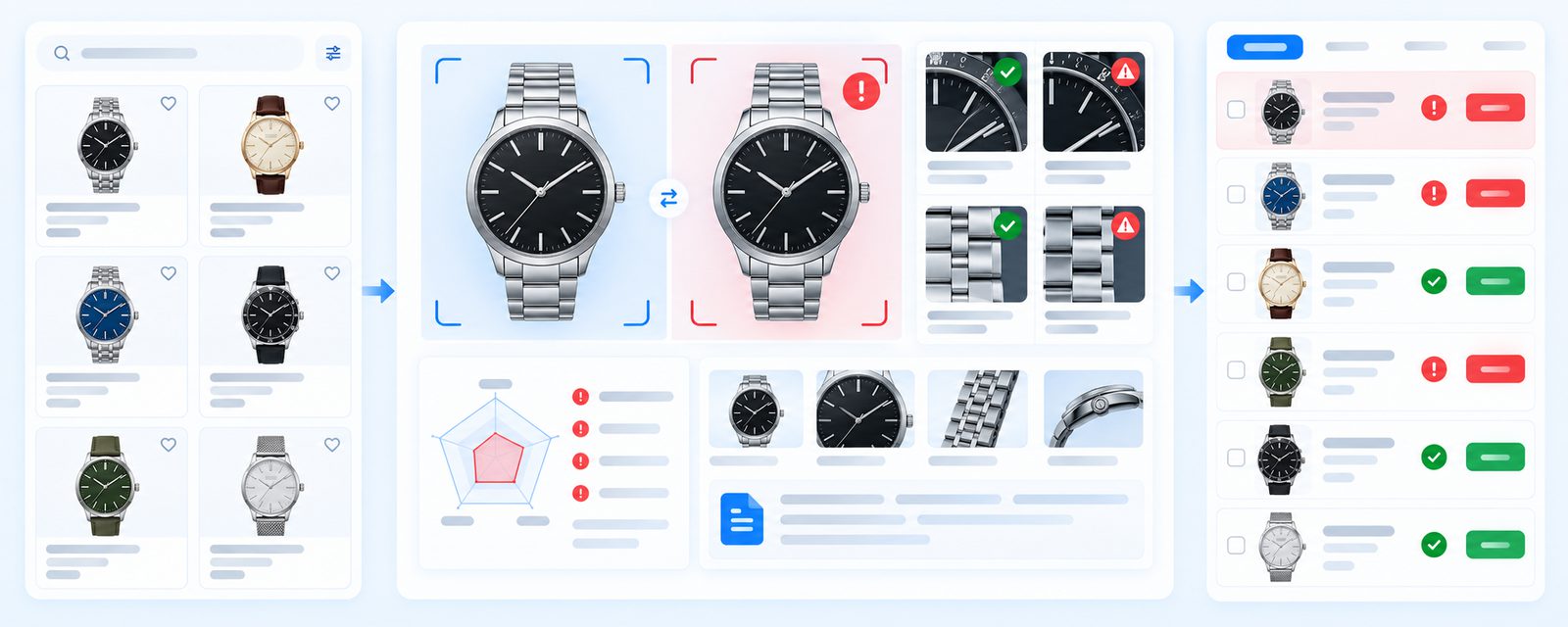
The parallel-import wrinkle specific to watches
Watches also carry a genuine grey market that’s easy to confuse with counterfeiting. Authorised-dealer stock gets diverted across regions and resold outside its intended market, which is real, genuine product, just sold through a channel the brand didn’t approve for that region. This is a fundamentally different problem from a counterfeit listing, and treating the two the same way leads to wasted enforcement effort, a grey-market listing generally isn’t reportable as intellectual property infringement the way a counterfeit is, since there’s no fake product involved, only an unauthorised sales channel. A brand needs to tell these two apart before deciding how to respond to either, since the fix for one (a takedown request) does nothing for the other (a distribution or channel-agreement issue).
What actually catches this at brand scale
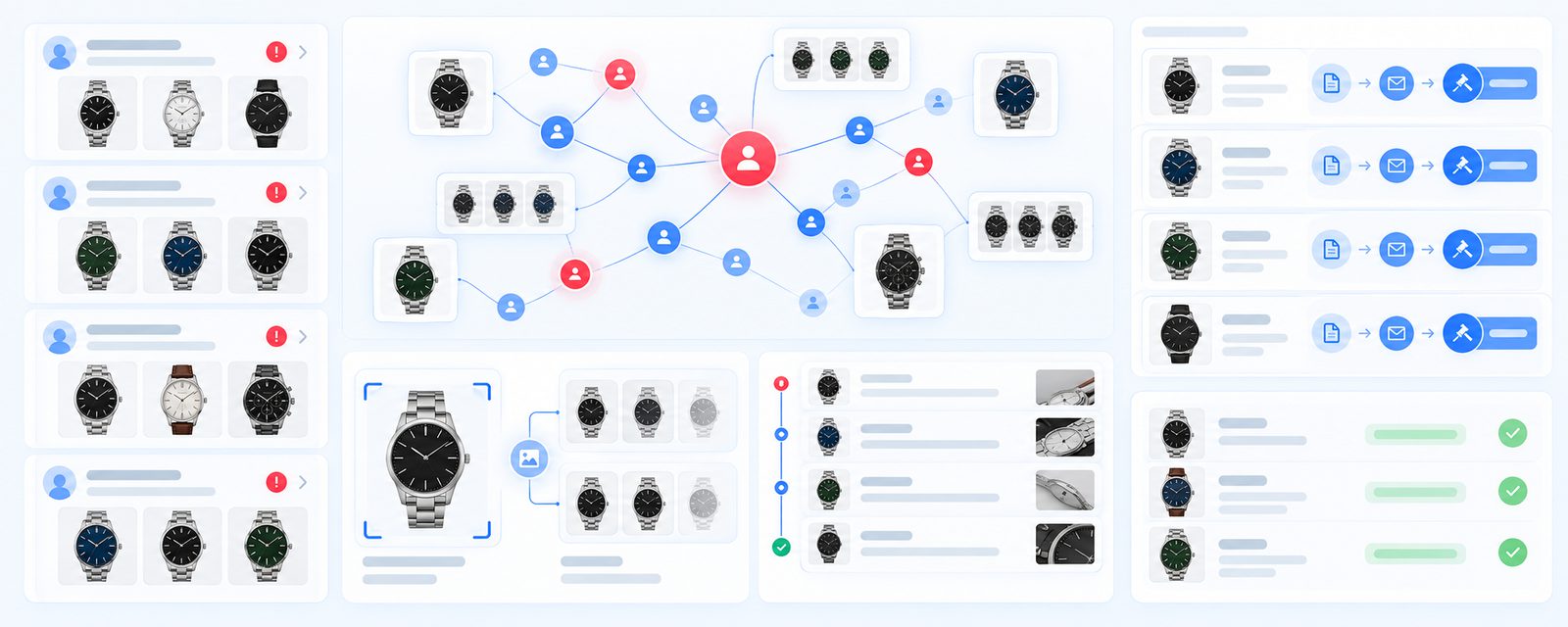
Continuous monitoring across every marketplace a brand’s watches actually sell on, matched against the brand’s real catalogue at SKU level, is what closes the gap that any single platform’s authentication programme leaves open. That coverage has to include marketplaces without their own dedicated authentication service at all, and has to catch listings below whatever price threshold a platform like eBay’s programme happens to use, since counterfeiters have every incentive to price just under that line. Truviss’s Marketplace Scanner applies this detect-verify-enforce approach across marketplaces, watching for counterfeit listings continuously rather than relying on any single platform’s built-in protections to catch everything on a brand’s behalf.
Getting started
A watch brand or authorised dealer’s starting checklist looks different from a generic brand-protection one. Confirm which marketplaces actually carry the brand’s sales volume and counterfeit exposure, not just the largest platforms by default. Check whether existing monitoring reaches below whatever price threshold a platform’s own authentication programme covers, since that’s exactly where counterfeiters have the most room to operate undetected. And build a clear process for separating grey-market findings from genuine counterfeit ones before responding to either, since misclassifying one as the other wastes enforcement effort and can even damage a brand’s standing with the platform reviewing future reports.
The pattern isn’t limited to watches either — one investigation found 67% of online cosmetics listings were fake, using much the same seller-side tactics.

Mithileshkumar leads growth at Truviss, working every day to make sure the brands losing the most to counterfeits, fraud and digital impersonation are the ones who find out about a fix first. He’s spent his career believing that good marketing isn’t about noise, it’s about showing up right when someone needs the answer. Off the clock, he’s usually chasing the same instinct in something entirely unrelated to work.