Protecting Intellectual Property in E-commerce: The Complete Guide (2026)
See how Truviss’s Marketplace Scanner catches counterfeit listings the moment they go live.
Book a demo
- Counterfeit goods made up an estimated USD 467 billion in global trade in 2021, 2.3% of world trade, and e-commerce has made it easier for fakes to reach buyers directly.
- The most common IP threats in e-commerce are counterfeit listings, unauthorised resellers, and image/content theft on marketplace pages.
- Manual reporting to marketplaces one listing at a time cannot keep pace with how quickly new fakes appear.
- A documented, evidence-backed process (detect, verify, enforce) protects both revenue and any future legal action.
What intellectual property infringement looks like in e-commerce
For most brands selling online, intellectual property infringement isn’t a single dramatic event, it’s a slow accumulation of smaller ones. A counterfeit listing undercutting price on a major marketplace. Product photography lifted directly from a brand’s own site and used to sell a fake. A reseller account with no real authorisation trading on a brand’s name to look legitimate. Each of these is a form of online brand protection failure, and each one chips away at revenue and customer trust in a way that’s easy to miss until it’s already widespread.
Global trade in counterfeit goods reached an estimated USD 467 billion in 2021, equivalent to 2.3% of total world trade, and EU imports of fakes alone were valued at EUR 99 billion, or 4.7% of the EU’s imports from outside the bloc (OECD/EUIPO, Mapping Global Trade in Fakes 2025). E-commerce is a large part of why: a counterfeit seller no longer needs a physical storefront or a distribution network, just a marketplace account and a product photo to copy.
Why marketplaces are a particular risk
Marketplaces solve a genuine problem for brands, reach and distribution without owning the infrastructure, but that same openness is what counterfeit sellers exploit. Clothing, footwear and leather goods jointly accounted for 62% of all counterfeit goods seized globally (OECD/EUIPO, Mapping Global Trade in Fakes 2025), categories that also happen to be some of the most heavily traded on consumer marketplaces. A fake listing doesn’t need to fool everyone, it only needs to look convincing enough at the moment of purchase, and a lower price than the genuine product is often all the nudge a buyer needs.
The problem compounds because a single successful fake listing tends to attract copies. Once one seller demonstrates a counterfeit can stay live long enough to generate sales, others list the same product, and a brand can find itself facing a dozen near-identical infringing listings instead of one.
The real cost of unprotected IP online
The direct cost is lost sales, a customer who buys the fake was never going to buy the genuine product at that moment. But the larger cost is usually indirect. A customer who receives a counterfeit product and doesn’t realise it’s fake will often leave a negative review against what they believe is the real seller, damaging star ratings and search ranking that the genuine brand worked to build. Paid search and marketplace advertising can also end up funding the problem: ad clicks convert on whichever listing ranks best at that moment, and a well-optimised fake can quietly absorb ad spend meant for the real product.
None of this shows up cleanly in a standard sales or marketing report. It requires actively looking for it.
Manual enforcement versus continuous monitoring
Most brands start IP enforcement the way they start most operational problems: manually. Someone on the team periodically searches marketplaces for obvious fakes and files a report through the platform’s own process. This works, up to a point. It catches the most blatant infringements and it costs nothing beyond time.
Where it breaks down is scale and speed. A new counterfeit listing can go live and start generating sales within hours, long before a periodic manual search would find it. Multiply that across every marketplace, region and product line a brand sells, and manual searching simply cannot keep pace with how quickly new listings appear. Continuous, automated monitoring exists to close that gap, not by replacing human judgement, but by surfacing candidates for review the moment they appear rather than weeks later.
Building a takedown process that holds up
A durable enforcement process generally follows three stages:
Detect continuously, not periodically. Scanning that runs 24/7 across the marketplaces and channels where a brand actually sells, matched against real product images, pricing and seller history rather than keyword search alone.
Verify against the brand’s actual catalogue. This is the step that protects genuine resellers and authorised partners from being mistakenly caught up in enforcement, and it’s also what gives a takedown request credibility with the platform reviewing it.
Enforce with a documented trail. Every detected listing and every enforcement action should be logged, not just for the immediate takedown, but as evidence if a case ever escalates beyond a single platform’s own process.
See how Truviss runs this detect, verify, enforce cycle across marketplaces automatically.
Explore Marketplace ScannerCommon mistakes brands make
The most common mistake is treating IP protection as a one-off clean-up rather than an ongoing process. A brand runs a sweep, removes the listings it finds, and moves on, only for a fresh batch of counterfeit listings to appear within weeks because nothing is actively watching afterward.
A close second is inconsistent evidence. Reporting a listing without documenting when it was found, what made it identifiable as counterfeit, and what happened after the report was filed makes it much harder to demonstrate a pattern if a case needs to go further than a single marketplace’s internal process.
A third is assuming marketplace reporting tools alone are enough. They’re built for occasional individual reports, not for identifying every new instance of a repeat-offending seller across multiple listings and storefronts.
Getting started
Start with whichever channel carries the biggest exposure. For most consumer brands selling through third-party marketplaces, that’s counterfeit listings; for others it may be typosquatted domains or impersonator accounts. Get continuous monitoring in place on that one channel first, build a documented takedown process around it, then expand coverage as the process proves itself.
Frequently asked questions
Search your brand name and product names on the marketplaces you sell through, and check for prices significantly below your own. Manual searching will catch the most obvious cases; continuous monitoring is what catches new listings as they appear rather than after they’ve been live for weeks.
Marketplace takedown requests are usually the fastest route since the platform can remove the listing directly. Legal action against the seller is a separate, slower process, and having a documented evidence trail from marketplace monitoring makes that route far more workable if it’s ever needed.
It shouldn’t, provided detection is verified against your actual product catalogue and known authorised sellers rather than triggered on keywords alone. This is why the verify step matters as much as detection itself.
This varies by marketplace and by how well-documented the takedown request is. A verified infringement with clear evidence is generally actioned faster than a vague report, which is why keeping a consistent evidence trail matters even for routine takedowns.
No. Smaller and mid-sized brands are targeted too, and often have fewer resources for manual monitoring, which makes an automated process more valuable relative to the size of the team available to run it.
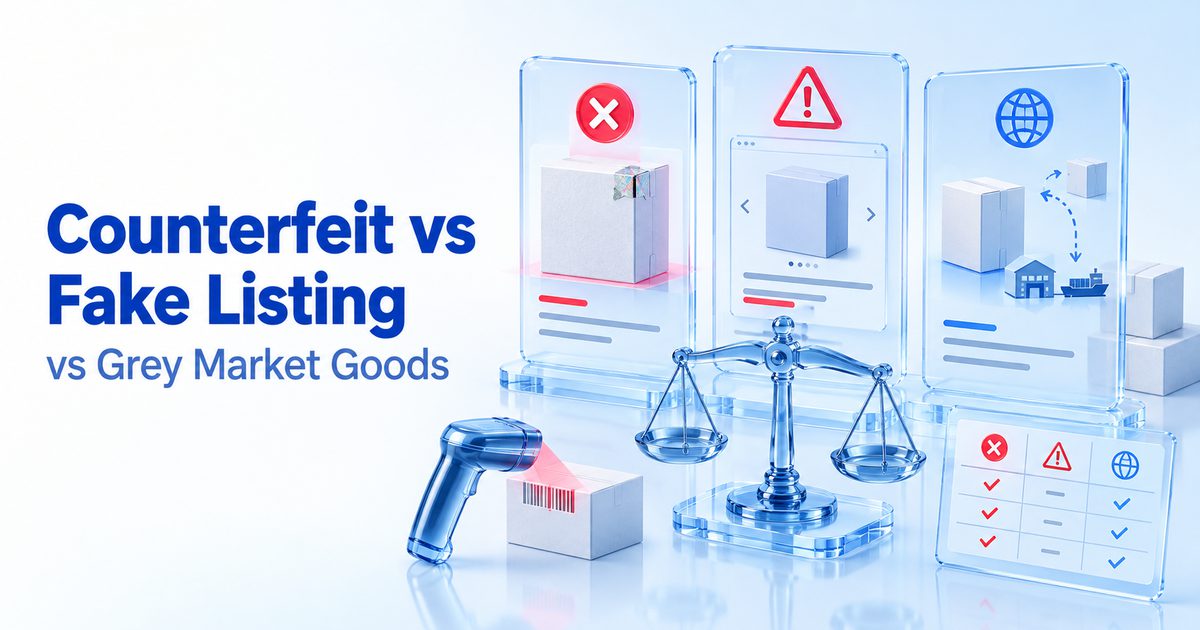
A counterfeit listing sells a fake product. An unauthorised reseller sells the genuine product outside the brand’s approved sales channels, which is a different (usually contractual, not IP) issue and typically requires a different response.