Truviss

Category: Marketplace Protection

  • How to Report Counterfeit Sellers: Amazon to Alibaba

    How to Report Counterfeit Sellers: Amazon to Alibaba

    Home/Blog/How to Report Counterfeit Sellers: Amazon to Alibaba
    Marketplace Protection

    How to Report Counterfeit Sellers: Amazon to Alibaba

    Stop filing these reports one at a time

    Truviss’s Marketplace Scanner finds counterfeit listings and builds the evidence trail automatically, across 5,000+ marketplaces.

    Book a demo
    How to Report Counterfeit Sellers cover
    TL;DR
    • Amazon, Flipkart and Alibaba each run their own brand-protection reporting programme, and each expects a slightly different form of evidence.
    • Amazon Brand Registry and Project Zero are the two routes for enrolled brands; Flipkart and Alibaba’s IP Protection Platform work similarly but through their own portals.
    • A report with clear evidence, listing URL, screenshots, and how it differs from the genuine product, gets actioned faster than a vague complaint.
    • Manual reporting works for occasional cases; it cannot keep pace with a seller who relists under a new account within days.

    Before you report: what to document

    Every marketplace’s reporting process wants roughly the same core evidence, regardless of platform: the exact listing URL, the seller’s name or ID, and a clear explanation of what makes the listing a fake product listing rather than a genuine one. Screenshots of the listing, taken at the time you find it, matter more than they might seem, since a seller can edit or remove a listing the moment they suspect a report is coming.

    If you’re reporting on behalf of a brand rather than as an individual buyer, most programmes also ask for proof of trademark ownership before granting full enforcement access, so it’s worth having that documentation ready before you start.

    Reporting on Amazon

    Brands enrolled in Amazon Brand Registry can report suspected counterfeits directly through the Report a Violation tool in Seller Central, which routes the report to Amazon’s enforcement team with the listing and seller details attached. Project Zero, available to a subset of enrolled brands, goes further and lets a brand remove counterfeit listings itself without waiting on Amazon’s review, using the brand’s own product data to automatically flag matches. Brands not yet enrolled in Brand Registry can still report through Amazon’s general intellectual property infringement form, though enrolled brands typically see faster action.

    Reporting on Flipkart

    Flipkart handles brand-protection reports through its own seller-and-brand support channel, generally requiring the same core evidence, listing link, seller details and a description of the infringement, submitted alongside proof of trademark ownership for the reporting brand. Response times and the exact submission flow can vary by category, so it’s worth checking Flipkart’s current seller help documentation for the specific reporting form before submitting, rather than assuming a fixed process across every category.

    Reporting on Alibaba

    Alibaba’s IP Protection Platform is the dedicated channel for reporting counterfeit listings across its marketplaces, letting a brand submit trademark or copyright evidence once and then file infringement reports against specific listings using that verified record. Because Alibaba spans multiple marketplaces under one group, verifying IP ownership through the platform once tends to make follow-up reports faster than starting from scratch each time.

    See how Truviss automates the evidence-gathering step across all three marketplaces and 5,000+ others.

    Explore Marketplace Scanner

    Why one-off manual reporting struggles at scale

    Filing one report against one listing works fine for an occasional, obvious case. It breaks down once a repeat offender starts relisting the same counterfeit product under a new seller account or a slightly altered listing title within days of being taken down. A brand that only reports what it happens to notice will keep losing ground to sellers who relist faster than the brand can search and file new reports.

    This is the gap continuous marketplace monitoring is built to close, not by replacing the reporting process on any of these platforms, but by finding new instances the moment they appear and keeping the evidence trail ready before a report is even filed.

    Getting started

    If a brand sells through more than one of these marketplaces, start by getting properly enrolled in each platform’s own brand-protection programme, Brand Registry for Amazon, the equivalent verification step for Flipkart and Alibaba, since enforcement access and speed both improve once a brand’s ownership is verified. From there, the biggest gain usually comes from moving off periodic manual searches and toward continuous monitoring for whichever marketplace carries the most sales exposure.

    Frequently asked questions

    Do I need to be enrolled in Amazon Brand Registry to report a counterfeit?

    No, Amazon’s general intellectual property infringement form is open to any rights owner. Brand Registry enrolment typically speeds up review and unlocks additional tools like Project Zero, but it isn’t required to file an initial report.

    How long does a marketplace typically take to act on a report?

    This varies by platform and by how complete the report is. A report with clear listing evidence and verified trademark ownership is generally actioned faster than one missing documentation, which is why preparing evidence before filing matters.

    What happens if the same seller relists after being taken down?

    You generally need to file a fresh report against the new listing, since a takedown applies to the specific listing reported, not automatically to future relistings under a new account. This is the main reason continuous monitoring matters more than a single successful report.

    Is reporting a counterfeit listing the same as reporting an unauthorised reseller?

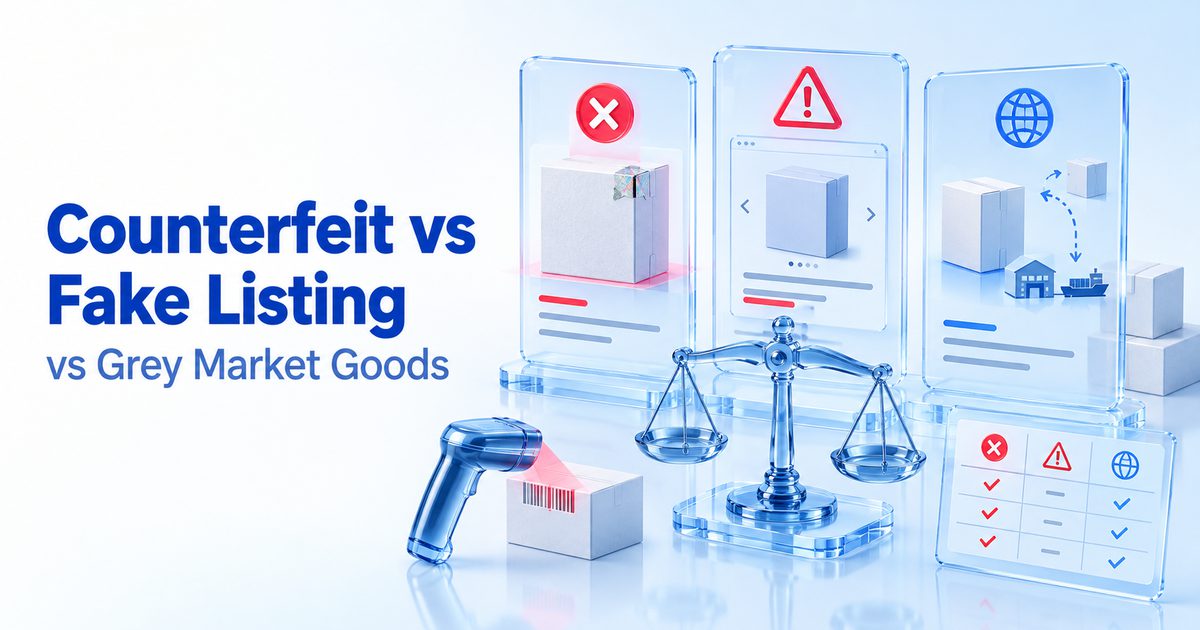
    No. A counterfeit listing sells a fake product and is generally handled through a platform’s IP infringement process. An unauthorised reseller sells the genuine product outside approved channels, which is usually a contractual issue handled differently and may not qualify for the same IP-based takedown route.

  • Brand Protection 2026: What’s Actually Working

    Brand Protection 2026: What’s Actually Working

    Home/Blog/Brand Protection 2026: What’s Actually Working
    Marketplace Protection

    Brand Protection 2026: What’s Actually Working

    Brand Protection 2026 cover
    TL;DR
    • Counterfeit goods made up an estimated USD 467 billion in global trade in 2021, 2.3% of world trade (OECD/EUIPO), and digital channels have made fakes easier to reach buyers directly than ever before.
    • Brand abuse now spans five fronts: marketplaces, social media, domains, app stores and ad networks, not just counterfeit listings.
    • Governments are naming and tracking the worst offenders: the USTR’s 2025 Notorious Markets List is the latest annual accounting of where counterfeiting concentrates online.
    • A detect, verify, enforce process, run continuously rather than as a periodic sweep, is what actually keeps pace with how fast new infringements appear.

    What digital brand abuse looks like in 2026

    Brand abuse used to mean one thing: a counterfeit product. It now means five. A counterfeit listing undercutting price on a marketplace. A cloned social media profile running a fake giveaway in a brand’s name. A lookalike domain harvesting customer logins. A cloned mobile app collecting data under a familiar-looking icon. A fraudulent ad steering search traffic toward a fake storefront. Each is a distinct attack surface, and each one is a form of online brand abuse that most brands only discover after a customer complains.

    What’s changed isn’t the intent behind any of this, it’s the speed and the surface area. A counterfeit operation no longer needs a warehouse or a distribution deal, just a marketplace account and a copied product photo. A phishing operation no longer needs to compromise a brand’s own servers, just a domain that looks close enough at a glance.

    How big the problem actually is

    Global trade in counterfeit goods reached an estimated USD 467 billion in 2021, equivalent to 2.3% of total world trade, and EU imports of fakes alone were valued at EUR 99 billion (OECD/EUIPO, Mapping Global Trade in Fakes 2025). Clothing, footwear and leather goods jointly accounted for 62% of all counterfeit goods seized globally, categories that also happen to be among the most heavily traded on consumer marketplaces.

    Those figures cover physical seizures. They understate the digital side of the problem, the impersonator accounts, phishing domains and cloned apps that never show up in a customs report because nothing physical ever crosses a border. A brand can lose customer trust to a fake Instagram giveaway or a typosquatted domain without a single counterfeit unit ever being seized.

    The five fronts: where brand abuse actually happens

    Marketplaces remain the biggest single channel, covering everything from major platforms to regional and vertical ones, and quick-commerce apps have added a newer, faster-moving front on top of that. Truviss’s Marketplace Scanner covers 5,000+ of them, matching listings against a brand’s real catalogue at SKU level rather than by keyword alone.

    Social media is close behind: fake profiles and scam pages on Facebook, Instagram, X, TikTok and YouTube trade on a brand’s name and following to run scams the real brand never sanctioned. Domains are the quieter threat, lookalike and typosquatted URLs built to harvest logins or payment details before a customer notices the misspelling. App stores add a fourth front, cloned or rogue apps on iOS and Android that mimic a brand’s real app closely enough to pass a casual glance. And ad networks are the fifth, fraudulent ads that redirect paid search or social traffic straight to a fake storefront, quietly spending a competitor’s or counterfeiter’s budget against a brand’s own customers.

    Case in point: a fake sold as genuine on a mainstream marketplace

    This isn’t a hypothetical. Truviss has seen the pattern play out with a real client, one of India’s leading helmet manufacturers, whose helmets were counterfeited and sold on Amazon by unauthorised resellers at 30-40% below the genuine price, with repeat offenders relisting after being reported. It didn’t need to fool every buyer, only enough of them, on a platform mainstream enough that shoppers don’t think to double-check.

    Daily scanning combined with computer vision image matching against the brand’s own catalogue was what eventually mapped the reseller network and gave Amazon’s IP enforcement team enough evidence to act.

    What regulators are doing about it

    Governments are paying closer attention too. The US Trade Representative’s 2025 Review of Notorious Markets for Counterfeiting and Piracy, published in 2026, is the latest edition of an annual list naming the online and physical markets where counterfeiting concentrates most. Being named on the list carries no direct legal penalty, but it is a public signal that puts pressure on the platforms and marketplaces involved, and it gives brands and their legal teams a citable, government-sourced reference point when building an enforcement case.

    Regulatory pressure alone doesn’t remove a single fake listing, though. That still comes down to a brand’s own monitoring and enforcement process, applied consistently, not just when a list like this makes headlines.

    Detect, verify, enforce: the process that actually works

    The brands that keep pace treat brand protection as a continuous process, not a periodic clean-up. It comes down to three steps, repeated constantly.

    Detect continuously, not periodically. Scanning that runs 24/7 across every channel where a brand actually has exposure, analysing 500+ data points per listing, images, pricing, seller history and text together, rather than keyword search alone.

    Verify against the brand’s real catalogue, at SKU level. This is what protects genuine resellers and authorised partners from being caught up in enforcement by mistake, and it’s what gives a takedown request credibility with the platform reviewing it.

    Enforce with a documented evidence trail, URLs, screenshots and timestamps logged for every action, not just the immediate takedown but as a record if a case ever needs to escalate beyond a single platform’s own process.

    See how Truviss runs detect, verify, enforce automatically across marketplaces, social media, domains and apps.

    Explore Marketplace Scanner

    Where to start

    Start with whichever front carries the biggest exposure. For most consumer brands that’s still counterfeit listings on marketplaces, but a brand with a strong social following may find impersonator accounts the more urgent risk, and one running paid acquisition may be losing more to ad fraud than it realises. Get continuous monitoring in place on that one channel first, build a documented takedown process around it, then expand coverage as the process proves itself.

    Frequently asked questions

    Is counterfeiting still mostly a physical-goods problem, or is it mostly online now?

    Both, and increasingly the two are connected. A counterfeit product still has to be manufactured somewhere, but the sale, discovery and distribution to the buyer now happens almost entirely through digital channels, marketplaces, social media and search ads, which is why digital monitoring has become as important as any physical enforcement.

    Which channel should a brand worry about first?

    Whichever carries the most exposure for that specific brand. A brand sold heavily through third-party marketplaces should prioritise counterfeit listing monitoring; a brand with a large social following should prioritise impersonator detection. There’s no universal answer, it depends on where the brand’s own customers actually are.

    Does being named on a list like the USTR’s Notorious Markets List actually change anything?

    It doesn’t remove listings directly, but it adds public and diplomatic pressure on the named markets and platforms, and it gives brands a citable, government-sourced reference point when making the case for stronger enforcement with a specific marketplace or registrar.

    Is this only a problem for large, globally recognised brands?

    No. Smaller and regional brands are targeted too, and often with less visibility since they have fewer resources for manual monitoring, which makes continuous, automated detection proportionally more valuable for a smaller team.

  • AliExpress Fine Proves Platform Moderation Isn’t Enough

    AliExpress Fine Proves Platform Moderation Isn’t Enough

    Home/Blog/AliExpress Fine Proves Platform Moderation Isn’t Enough
    Marketplace Protection

    AliExpress Fine Proves Platform Moderation Isn’t Enough

    Don’t wait for platform moderation to catch it

    Book a demo to see how Truviss’s Marketplace Scanner monitors your own catalogue across the marketplaces that matter to you.

    Book a demo
    AliExpress Fine Proves Platform Moderation Isn't Enough cover
    TL;DR
    • The European Commission fined AliExpress €550M ($629M) in July 2026 under the Digital Services Act for failing to catch counterfeit goods, unsafe toys and dangerous cosmetics for extended periods.
    • This is a regulator, not a vendor, formally confirming that platform-wide moderation misses counterfeit listings at scale, even on a platform with strong incentive to catch them.
    • Generic marketplace moderation manages platform-wide risk, not any single brand’s specific catalogue.
    • SKU-level, brand-side monitoring catches what platform moderation misses, because it checks listings against the brand’s own real product data instead of generic patterns.

    In July 2026, the European Commission fined AliExpress €550 million (about $629 million) under the Digital Services Act. The finding: AliExpress failed to adequately assess and mitigate the risk of counterfeit goods, unsafe toys and dangerous cosmetics remaining listed on its platform for extended periods. EU Commission Executive Vice-President Henna Virkkunen put it directly, quoted by Fortune: “it is a failure by AliExpress to comply with its obligations under the Digital Services Act.”

    That’s not a brand-protection vendor making a point about marketplace moderation. That’s a formal regulatory finding, backed by an investigation, stating plainly that a major marketplace’s own enforcement missed counterfeit and unsafe listings at scale, for extended periods, on the platform with arguably the strongest regulatory incentive of any of them to catch it.

    Why this matters beyond AliExpress

    It’s tempting to read this as a story specific to one platform’s compliance failure, especially since coverage has framed it as part of a broader EU crackdown that also touches Temu and Shein. But the underlying mechanism isn’t AliExpress-specific.

    Every marketplace at this scale moderates the same way: automated review across millions of listings, with human review reserved for whatever gets flagged. A brand’s own products sitting somewhere in that queue are one entry among millions. The platform’s incentive is managing aggregate risk, avoiding exactly the kind of regulatory exposure AliExpress just got fined for, not protecting any single brand’s specific catalogue.

    What the EU’s finding adds is independent, formally investigated confirmation that this gap is real and material. It’s not a hypothetical raised to sell a monitoring tool. A regulator spent the time to establish that counterfeit and unsafe listings stayed up for extended periods, on a platform that had every incentive not to let that happen.

    The categories named in the finding are worth sitting with too: counterfeit goods alongside unsafe toys and dangerous cosmetics. These aren’t fringe, low-stakes product types. A toy or a cosmetic that stays listed while unsafe or counterfeit isn’t just a lost sale for the genuine brand, it’s a product a customer can actually be harmed by, sold under conditions a regulator has now formally said weren’t adequately assessed. If a marketplace’s moderation missed that combination for an extended period, there’s no reason to assume it’s reliably catching the narrower, harder-to-spot case of one specific brand’s counterfeit listing sitting a few pages deep in search results.

    What this means for a brand’s own monitoring

    If the platform with a formal regulatory obligation to catch counterfeit listings still missed them for extended periods, no brand should assume its own listings on that platform, or any platform, are being adequately watched on its behalf.

    The fix isn’t waiting for platform-wide moderation to improve. Generic moderation is built to catch patterns across everyone’s listings at once, which is exactly why it misses things that only look wrong when checked against one specific brand’s real catalogue. That’s what SKU-level matching does differently: instead of pattern-matching a listing against other known fakes, it checks the listing against the brand’s own real product data, real SKUs, real images, real pricing bands. A listing can dodge a pattern built from other counterfeits far more easily than it can fabricate a match against a brand’s genuine catalogue.

    See how Truviss’s Marketplace Scanner monitors your catalogue across marketplaces, continuously.

    Explore Marketplace Scanner

    This is the specific gap Truviss’s Marketplace Scanner is built to close: continuous marketplace monitoring run from the brand’s side, across the marketplaces that matter to that brand, rather than relying on any single platform’s internal enforcement to catch what shouldn’t have been listed in the first place. A counterfeit listing doesn’t need to survive platform-wide moderation forever to do damage, it only needs to survive long enough to take sales, collect reviews under the wrong name, and put a customer at risk with a product the brand never made.

    The AliExpress fine is a useful, concrete reminder of why that distinction matters. It’s also a reminder that the timeline matters as much as the outcome: a regulator’s finding of “extended periods” is a retrospective judgment, made after the harm already happened. A brand waiting for the same kind of after-the-fact confirmation on its own catalogue is accepting the same delay. Platform moderation exists to manage the platform’s aggregate risk across every seller and every category at once. It was never built, and per this finding, wasn’t even reliably managing that, to guarantee any one brand’s catalogue is clean in real time.

  • The Seventh Circuit Just Made Suing Counterfeiters Harder

    The Seventh Circuit Just Made Suing Counterfeiters Harder

    Home/Blog/The Seventh Circuit Just Made Suing Counterfeiters Harder
    Marketplace Protection

    The Seventh Circuit Just Made Suing Counterfeiters Harder

    Build the evidence trail before you need it

    Truviss’s Marketplace Scanner logs timestamped evidence continuously, so it’s ready whichever legal route a case eventually needs.

    Book a demo
    Seventh Circuit counterfeiting ruling cover
    TL;DR
    • Schedule A litigation lets brands sue many “hit-and-run” foreign online sellers at once in a single case, usually in the Northern District of Illinois, often with an asset freeze attached.
    • Two 2026 Seventh Circuit rulings narrowed the jurisdictional and service shortcuts that made these cases move fast against overseas sellers.
    • A separate, unrelated case, Richemont’s suit against a single named “superfake” jewelry seller, shows the different enforcement path available for an identifiable, higher-value counterfeiter.
    • The practical lesson for brands: courts now expect real proof of an actual sale and real service, not shippability and an email, which raises the bar for a brand’s own evidence-gathering too.

    Schedule A litigation has become one of the more effective legal tools brands use against online counterfeiters, and the mechanics explain why. Instead of filing a separate lawsuit against each “hit-and-run” seller, a brand can bring a single federal case naming many foreign-based online sellers at once, identified in an attached schedule of storefront names, URLs, seller IDs and email addresses rather than in the case caption itself. These cases are most often filed in the U.S. District Court for the Northern District of Illinois, frequently paired with a request to freeze the defendants’ assets before proceeds get moved offshore and out of reach. Rights owners who use Schedule A litigation generally see a significant reduction, sometimes an outright elimination, of the specific infringements targeted.

    The 2026 complication

    Two Seventh Circuit rulings this year have narrowed exactly the procedural shortcuts that made Schedule A cases move as fast as they do. In March, the court in Yinnv Liu v. Monthly et al. vacated a default judgment against online vendors accused of selling counterfeit goods, ruling that checkout-page screenshots showing a product could ship to Illinois aren’t enough to establish personal jurisdiction without actual evidence that a sale happened there. Then, on 29 May 2026, the court held in Kangol LLC v. Hangzhou Chuanyue Silk Import & Export Co., Ltd. that serving a Chinese defendant by email isn’t sufficient to establish personal jurisdiction over them.

    Both rulings target the same two shortcuts that had made Schedule A cases fast and comparatively cheap against overseas sellers, at least within the Seventh Circuit: loose jurisdictional proof based on shippability rather than actual sales, and quick service by email instead of more formal international channels. Neither ruling ends Schedule A litigation as a tool. Both make clear that plaintiffs need a stronger evidentiary record than courts previously required before they’ll get the fast default judgments this approach has relied on.

    A different enforcement path: what happens outside Schedule A

    Not every counterfeiting case follows this pattern, and a recent one shows the alternative clearly. In July 2025, Richemont International, joined by Cartier and Van Cleef & Arpels, filed suit against a single named defendant, Malidani Jewelry Corp, in the Southern District of New York, alleging the company sold “superfakes,” high-quality replicas of Cartier’s LOVE bracelet, Juste un Clou collection, and Van Cleef & Arpels’ Alhambra line, priced closely enough to the originals to compete directly with them. This is a traditional single-defendant trademark and trade dress case, not a bulk Schedule A filing, and it resolved differently too: a consent judgment gave Richemont a permanent injunction against Malidani plus a $205,000 payment.

    The contrast matters. Schedule A exists specifically for the high-volume, low-value, hard-to-identify “hit-and-run” seller problem, where individually pursuing each of dozens or hundreds of sellers wouldn’t be worth the cost. A single, identifiable, higher-value counterfeiter like Malidani is a different kind of target entirely, and a traditional single-defendant suit with a real settlement and injunction is often the more direct route. Knowing which situation a brand is actually facing, a wave of anonymous foreign storefronts versus one identifiable seller, determines which legal tool actually fits.

    See how Truviss identifies which situation you’re facing, an anonymous seller wave or one identifiable counterfeiter, before you choose an enforcement path.

    Explore Marketplace Scanner

    What this actually means, without overstating either direction

    It would be easy to read the Seventh Circuit rulings two ways, and both would be wrong. This isn’t the collapse of Schedule A litigation, brands are still filing these cases and courts elsewhere haven’t followed the Seventh Circuit’s specific reasoning. But it’s also not a minor procedural footnote. Legal commentary tracking this space has started asking directly whether Schedule A litigation, at least in its fastest and cheapest form, is heading toward a real decline, not because the underlying legal theory is weaker, but because the evidentiary bar for the personal jurisdiction and service shortcuts that made it fast just went up in one circuit that has handled a large share of these cases.

    The practical effect for a brand considering this route: proving that a product could theoretically ship to a jurisdiction is no longer treated as equivalent to proving an actual sale happened there, and emailing a defendant overseas is no longer treated as adequate notice on its own. Both of those used to be enough to get a quick default judgment. Now they aren’t, at least in the Seventh Circuit, and other circuits may or may not follow.

    What this means for a brand’s own evidence-gathering

    The direct lesson for a brand’s own monitoring is about evidence quality, not legal strategy. If courts now expect proof that a sale genuinely occurred in a specific jurisdiction rather than just that a listing could theoretically reach it, a brand’s own documentation needs to move in the same direction, verified transaction records, timestamped screenshots tied to a specific sale, not just a listing’s shipping settings. This is the same underlying principle behind any well-built takedown request, whether it’s aimed at a marketplace’s own reporting process or a Schedule A filing: the strength of the case rests on the quality of the evidence trail collected before anyone files anything, not on the legal mechanism chosen afterward. A brand building that evidence trail continuously, rather than reconstructing it after deciding to pursue a specific legal route, is the one positioned to act quickly whichever direction courts move next.

  • Fake Trademark Deeds Now Hijack Marketplace Listings

    Fake Trademark Deeds Now Hijack Marketplace Listings

    Home/Blog/Fake Trademark Deeds Now Hijack Marketplace Listings
    Marketplace Protection

    Fake Trademark Deeds Now Hijack Marketplace Listings

    Watch who controls your listings

    Truviss’s Marketplace Scanner tracks Buy Box and seller-identity changes on your own listings, catching an ownership hijack before it costs you your reviews and sales history.

    Book a demo
    Fake Trademark Deeds Now Hijack Marketplace Listings cover
    TL;DR
    • Counterfeiters are forging trademark registration certificates and assignment deeds to convince marketplaces they own a brand, then taking over the real seller’s listing.
    • Standard counterfeit-detection tooling (image, price, duplicate-listing checks) doesn’t catch this: the product and price stay the same, only who controls the listing changes.
    • The fix is monitoring listing ownership and seller-identity changes directly, not adding another layer of counterfeit-image detection.
    • Speed matters once it happens: reviews and sales history built over years keep accruing to the hijacker until the listing is reclaimed.

    A seller on Amazon spends years building a listing: real product, real reviews, real sales rank. Then one day the Buy Box quietly changes hands. Not because a shopper preferred someone else’s price. Because someone else submitted a trademark assignment deed claiming they, not the original seller, own the brand behind that listing, and the marketplace’s verification process accepted it.

    This is happening on marketplaces right now, and it isn’t a counterfeit-detection problem in the sense most brand-protection advice assumes. It’s a document-fraud problem aimed squarely at the marketplace’s own trust process, and it’s catching sellers who did everything else right.

    How the forgery actually works

    Counterfeiters used to need a convincing fake product. Increasingly, they don’t bother faking the product at all, they fake the paperwork that proves who owns the brand behind it. Business Standard’s reporting on this (15 July 2026, “Fake signatures, fake lawyers: Counterfeiters outsmart online marketplaces”) documented forged trademark registration certificates, fabricated assignment deeds, and fake legal letterhead submitted to convince a marketplace that the submitter, not the actual brand owner, holds the rights.

    Once that claim is accepted, the marketplace treats the forger as the legitimate rights-holder. That’s the part that makes this different from a normal counterfeit listing: the marketplace isn’t being fooled by a bad product, it’s being fooled by paperwork that looks exactly like the real documentation it’s designed to accept. A trademark certificate is a trademark certificate to an automated verification queue processing thousands of submissions; it doesn’t inherently know that this particular one is fabricated. From there, the forger can attach their own offer to the real seller’s existing listing (a Buy Box takeover, riding on reviews and sales history they never earned) or, in more aggressive cases, file a false infringement complaint against the real seller using the fabricated ownership claim, getting the genuine listing suspended entirely.

    Why standard counterfeit-detection tooling misses this

    The existing brand-protection playbook, and every major vendor’s published guide to it, is built around one assumption: the brand owner is the one filing evidence to get someone else’s bad listing removed. Red Points, BrandShield, Corsearch and mFilterIt all publish detailed guides on exactly that process: identify the infringement type, gather proof of ownership, submit it to the platform, wait for a response. All of it assumes your ownership status isn’t in dispute.

    None of it covers the inverted case: a brand owner losing control of their own listing because somebody else’s forged paperwork got accepted first. If your detection tooling is watching for counterfeit images, suspicious pricing, or duplicate listings, none of those signals fire here. The product photos are real. The price is normal. The listing itself hasn’t changed at all except who controls it. This is a gap in what “counterfeit detection” usually means, not a failure of any one vendor’s execution of it.

    What actually catches it: watching who controls the listing, not just what’s on it

    If the attack targets ownership and identity rather than product or price, the defence has to watch the same thing: who controls a listing, and when that control changes. That means monitoring Buy Box reassignment on your own listings, tracking seller-identity changes behind a product page that previously belonged to you, and treating an unexplained ownership or seller-ID shift as a signal worth investigating immediately, not something that surfaces weeks later in a routine audit.

    This is a different job from scanning marketplaces for lookalike products or counterfeit images, and it’s the specific gap Truviss’s Marketplace Scanner is built to close: continuous marketplace monitoring of listing and seller-identity signals, not a one-time image sweep. A related but distinct problem worth knowing about too: AI-generated fake product listings built from synthetic photos rather than forged paperwork, covered separately since the mechanism and the fix both differ from what’s described here.

    See how Truviss’s Marketplace Scanner tracks Buy Box and seller-identity changes on your own listings.

    Explore Marketplace Scanner

    What to do if it’s already happened

    Speed matters more than thoroughness here, because every day the hijack goes unresolved, the reviews and sales history a legitimate seller built over years keep accruing to someone who took the listing by forging a document, not by earning it.

    Gather what actually proves prior ownership: the original trademark registration in your name, dated records of when you first listed the product, and the specific date the Buy Box or listing control changed hands. Escalate directly to the marketplace’s brand-registry or IP-enforcement team rather than a general seller-support queue; general support often isn’t equipped to adjudicate a competing ownership claim and will default to whichever document was submitted first. If the marketplace’s takedown process stalls because it’s treating this as a dispute between two rights-holders rather than a fraud case, be explicit that the submitted documents are forged, not merely contested, and provide whatever evidence supports that (verifiable trademark office records, for instance) as directly as possible.

    The uncomfortable part of this is that the marketplace’s own verification step, the thing meant to protect legitimate sellers, is the exact mechanism being exploited. That’s not a reason to stop relying on platform enforcement, but it is a reason not to treat “the marketplace verifies ownership” as a defence on its own. It’s a defence that fails silently, and the only reliable way to catch that failure is watching your own listings for exactly the kind of ownership change that shouldn’t be able to happen without your knowledge.

  • AI vs AI: Detecting AI-Generated Fake Product Listings

    AI vs AI: Detecting AI-Generated Fake Product Listings

    Marketplace Protection

    AI vs AI: Detecting AI-Generated Fake Product Listings

    See it before your buyers do

    Truviss’s Marketplace Scanner runs continuous listing- and seller-level detection across major marketplaces, catching fake listings before they reach a shopper’s screen.

    Book a demo
    AI vs AI: Detecting AI-Generated Fake Product Listings cover
    TL;DR
    • Generative AI removes the old bottleneck (real product photos) from running fake-listing operations at scale.
    • Detection has shifted from trusting the image itself to pixel-level generation artifacts, seller behaviour and pricing patterns, and cross-listing duplication fingerprints.
    • This is an ongoing arms race, not a solved problem: generation techniques adapt as detection signals become reliable.
    • Platform-side detection at listing creation, not buyer vigilance alone, is where this actually gets caught at scale.

    Direct answer: Generative AI now lets one bad actor produce unlimited unique product photos and listing copy for close to zero cost: no real product, no theft, no photography required. Detection AI is catching up, but not by trusting the image at face value anymore. It’s looking at pixel-level generation artifacts, pricing and behavioural patterns, and duplication across listings, the things a generated image can’t fully hide even when it looks perfect to a human eye.

    What changed: why 1,000 fake product listings from one seller is now cheap

    Until recently, running a large-scale counterfeit or scam operation on a marketplace had a real bottleneck: you needed actual product photos. That meant either owning real stock, stealing images from a legitimate seller, or paying someone to fake convincing shots. All three left a trail; stolen images show up in reverse image search, and physical stock has real logistics costs and lead time. Scaling a fake-listings operation past a handful of items used to require real effort, real risk of getting caught, and real money.

    Generative AI removed that bottleneck entirely. A single prompt now produces a unique product photo that has never existed anywhere else, showing a product from an angle, in a setting, with a background the seller never actually staged. That single fact quietly breaks the tool most buyers and even some platforms relied on for years: reverse image search. It only works by matching a suspect image against a prior instance somewhere on the internet. A generated image has no prior instance. It returns nothing, and buyers frequently mistake “no results” for “this looks clean” rather than “this tool can’t see it.”

    Feed that generated image into an LLM for the listing copy (description, specs, even a plausible seller bio) and one operator can seed hundreds or thousands of listing variants from a single laptop in an afternoon. Each one is visually and textually distinct enough to survive the kind of naive duplicate-detection that used to catch a seller copy-pasting the same stolen photo across twenty storefronts.

    That’s the actual shift, and it’s worth being precise about it: fraud didn’t get smarter in some abstract sense. The single biggest cost of running fake product listings at scale, sourcing convincing, unique-looking product imagery, simply disappeared. Everything downstream of that (more listings, more storefronts, faster iteration when one gets caught) follows from that one change.

    What detection AI actually looks for

    Since the image itself can no longer be trusted on sight, detection has moved to signals a generated image doesn’t fully erase, even when it fools a human at a glance:

    • Pixel-level generation artifacts. Generative models leave statistical fingerprints in the output: compression patterns, colour-consistency irregularities across regions of the same image, edge artifacts around fine detail like text, stitching, or reflective surfaces, that don’t match how a real camera sensor produces an image. This works without relying on metadata or watermarks, which matters because both are trivial for a seller to strip or fabricate. The analysis happens on the pixels themselves, not on anything the seller controls.
    • Pricing and behavioural anomalies. A listing priced meaningfully below market rate, posted by an account with no sales history, following a listing-creation and posting cadence typical of bulk-generated storefronts (many listings in a short window, similar structure across a seller’s catalogue, account created recently) is a real signal regardless of how convincing any single image looks. This is the part of detection that generated images can’t touch at all: it’s about seller behavior, not photo quality.
    • Cross-listing duplication and pattern-matching at scale. Even genuinely unique generated images tend to share subtle stylistic fingerprints traceable back to the specific model or generation pipeline that produced them. Looked at one listing at a time, that’s invisible. Looked at across thousands of listings, it’s enough to link many “different” sellers and “different” products back to one operator or one generation setup.

    Worth being precise about what “cross-listing duplication” is actually comparing against, too: these three signals still work by comparing listings to each other. A more durable variant compares listings to the brand’s own catalogue instead, real SKUs, real images, real pricing bands, rather than to other listings on the marketplace. A generated variant can dodge a pattern built from other fakes; it can’t generate a real product that matches the brand’s actual catalogue data, which is what makes catalogue-level matching a harder wall to scale past with AI alone.

    None of these require a human to eyeball a photo and decide, subjectively, whether it looks fake. That’s the actual point. At real marketplace scale, that job was already an impossible ask before generative AI made the images themselves harder to distinguish. Now it’s not even the right question to be asking.

    The arms race, not a solved problem

    This isn’t a story where detection AI “wins” once and the problem goes away. It’s continuous, and it’s worth saying that plainly rather than overselling detection as a finished solution. As soon as one detection signal becomes reliable, the generation side adapts specifically to defeat it, a pattern already visible in the wild, not a hypothetical. Some 2026-era scam variants specifically generate staged “unboxing” photography using AI (documented as “Empty Box Scams — Now With AI Photography”), precisely because that photographic format is what buyers have been trained, over years of legitimate unboxing content, to trust as proof a seller genuinely has the product in hand. The detection signal being targeted here, real photo versus generated, is the exact same one detection systems rely on. The generation side isn’t inventing a new attack; it’s directly countering the specific thing that would have caught it.

    That doesn’t make detection AI ineffective. It makes it a moving target, in the same structural way spam filtering has been a moving target for two decades: every improvement on one side prompts an adaptation on the other, and there’s no final state where the problem is permanently solved. The honest framing, and the one platforms with genuinely working detection systems tend to be upfront about rather than oversell, is that this reduces the volume and success rate of fraudulent listings meaningfully. It doesn’t eliminate them, and any claim that it does should be treated with suspicion.

    There’s also a real cost asymmetry underneath this arms race that’s worth naming directly. Generating a fake listing, one photo, one description, costs a fraction of a cent and takes seconds. Detecting it reliably requires running that listing through multiple independent signal checks, cross-referencing it against a seller’s full history and every other listing on the platform, and doing that continuously as new generation techniques emerge. The attacker’s cost stayed flat or dropped; the defender’s cost went up, because detection now has to account for a much larger space of possible fakes than “does this photo match a known stolen image.” That asymmetry is exactly why detection has had to become multi-signal rather than image-only: a single check that generation can defeat cheaply isn’t worth relying on alone.

    What marketplaces and platforms need to get right

    Buyer vigilance matters, but it isn’t where this problem actually gets solved at scale. That has to happen on the platform side, structurally, before a listing ever reaches a shopper’s screen. This is exactly the gap Truviss’s Marketplace Scanner is built to close: continuous listing- and seller-level detection across major marketplaces, not a one-time manual sweep.

    See how Truviss’s Marketplace Scanner catches AI-generated fake listings before they reach a shopper’s screen.

    Explore Marketplace Scanner
    • Detection at listing creation, not just after complaints roll in. By the time enough buyers have flagged a fake listing for a platform’s existing reporting system to catch it, that listing has often already made its sales and the operator has moved on to the next batch. Scanning new listings against generation-artifact and behavioural signals at upload time, the same point real-estate marketplaces have started applying this to duplicate and low-quality listings, catches the problem before it does damage, not after.
    • Treating seller-level patterns as seriously as listing-level ones. A single convincing fake listing is hard to catch with certainty. A seller account posting dozens of listings in an unusual cadence, with images sharing a subtle generation fingerprint across “different” products, is a much stronger signal, but only if the platform’s detection is built to look at the seller and the catalogue, not just one listing in isolation.
    • Being transparent about what verification actually means. A badge, checkmark, or “verified seller” label is only meaningful if it’s tied to something real: a documented business identity, a track record, an actual authentication step, rather than a cosmetic UI element that buyers learn to trust regardless of what backs it. Overselling a weak verification signal erodes trust in the stronger ones once buyers get burned.

    None of this is a one-time fix. It’s an operating posture: continuous monitoring, continuous adaptation, and honesty about the fact that some fraudulent listings will still get through, because the alternative (claiming a permanent fix) is itself a kind of false confidence that makes buyers let their guard down at exactly the wrong moment.

    What this means for buyers right now

    The old advice, “reverse image search the product photo before you buy,” is losing reliability specifically because generated images have no prior instance anywhere to search for in the first place, not because search engines got worse at their job. That doesn’t mean there’s nothing a buyer can still check themselves: seller history and review patterns over time, whether the price is sanely close to market rate for that specific product, and whether the listing platform itself offers any authentication or verification step that goes beyond the photo (a scan-to-verify mechanism, a seller-verification badge tied to something real, anything that isn’t just “trust the image”).

    But increasingly, catching sophisticated AI-generated fake listings is a platform-side detection problem that operates at a scale and with signals no individual buyer has access to, not something a careful shopper can reliably solve alone by staring harder at one product photo before checking out.

  • Protecting Intellectual Property in E-commerce: The Complete Guide (2026)

    Protecting Intellectual Property in E-commerce: The Complete Guide (2026)

    Home/Blog/Protecting Intellectual Property in E-commerce: The Complete Guide (2026)
    Marketplace Protection

    Protecting Intellectual Property in E-commerce: The Complete Guide (2026)

    Protecting Intellectual Property in E-commerce cover
    TL;DR
    • Counterfeit goods made up an estimated USD 467 billion in global trade in 2021, 2.3% of world trade, and e-commerce has made it easier for fakes to reach buyers directly.
    • The most common IP threats in e-commerce are counterfeit listings, unauthorised resellers, and image/content theft on marketplace pages.
    • Manual reporting to marketplaces one listing at a time cannot keep pace with how quickly new fakes appear.
    • A documented, evidence-backed process (detect, verify, enforce) protects both revenue and any future legal action.

    What intellectual property infringement looks like in e-commerce

    For most brands selling online, intellectual property infringement isn’t a single dramatic event, it’s a slow accumulation of smaller ones. A counterfeit listing undercutting price on a major marketplace. Product photography lifted directly from a brand’s own site and used to sell a fake. A reseller account with no real authorisation trading on a brand’s name to look legitimate. Each of these is a form of online brand protection failure, and each one chips away at revenue and customer trust in a way that’s easy to miss until it’s already widespread.

    Global trade in counterfeit goods reached an estimated USD 467 billion in 2021, equivalent to 2.3% of total world trade, and EU imports of fakes alone were valued at EUR 99 billion, or 4.7% of the EU’s imports from outside the bloc (OECD/EUIPO, Mapping Global Trade in Fakes 2025). E-commerce is a large part of why: a counterfeit seller no longer needs a physical storefront or a distribution network, just a marketplace account and a product photo to copy.

    Why marketplaces are a particular risk

    Marketplaces solve a genuine problem for brands, reach and distribution without owning the infrastructure, but that same openness is what counterfeit sellers exploit. Clothing, footwear and leather goods jointly accounted for 62% of all counterfeit goods seized globally (OECD/EUIPO, Mapping Global Trade in Fakes 2025), categories that also happen to be some of the most heavily traded on consumer marketplaces. A fake listing doesn’t need to fool everyone, it only needs to look convincing enough at the moment of purchase, and a lower price than the genuine product is often all the nudge a buyer needs.

    The problem compounds because a single successful fake listing tends to attract copies. Once one seller demonstrates a counterfeit can stay live long enough to generate sales, others list the same product, and a brand can find itself facing a dozen near-identical infringing listings instead of one.

    The real cost of unprotected IP online

    The direct cost is lost sales, a customer who buys the fake was never going to buy the genuine product at that moment. But the larger cost is usually indirect. A customer who receives a counterfeit product and doesn’t realise it’s fake will often leave a negative review against what they believe is the real seller, damaging star ratings and search ranking that the genuine brand worked to build. Paid search and marketplace advertising can also end up funding the problem: ad clicks convert on whichever listing ranks best at that moment, and a well-optimised fake can quietly absorb ad spend meant for the real product.

    None of this shows up cleanly in a standard sales or marketing report. It requires actively looking for it.

    Manual enforcement versus continuous monitoring

    Most brands start IP enforcement the way they start most operational problems: manually. Someone on the team periodically searches marketplaces for obvious fakes and files a report through the platform’s own process. This works, up to a point. It catches the most blatant infringements and it costs nothing beyond time.

    Where it breaks down is scale and speed. A new counterfeit listing can go live and start generating sales within hours, long before a periodic manual search would find it. Multiply that across every marketplace, region and product line a brand sells, and manual searching simply cannot keep pace with how quickly new listings appear. Continuous, automated monitoring exists to close that gap, not by replacing human judgement, but by surfacing candidates for review the moment they appear rather than weeks later.

    Building a takedown process that holds up

    A durable enforcement process generally follows three stages:

    Detect continuously, not periodically. Scanning that runs 24/7 across the marketplaces and channels where a brand actually sells, matched against real product images, pricing and seller history rather than keyword search alone.

    Verify against the brand’s actual catalogue. This is the step that protects genuine resellers and authorised partners from being mistakenly caught up in enforcement, and it’s also what gives a takedown request credibility with the platform reviewing it.

    Enforce with a documented trail. Every detected listing and every enforcement action should be logged, not just for the immediate takedown, but as evidence if a case ever escalates beyond a single platform’s own process.

    See how Truviss runs this detect, verify, enforce cycle across marketplaces automatically.

    Explore Marketplace Scanner

    Common mistakes brands make

    The most common mistake is treating IP protection as a one-off clean-up rather than an ongoing process. A brand runs a sweep, removes the listings it finds, and moves on, only for a fresh batch of counterfeit listings to appear within weeks because nothing is actively watching afterward.

    A close second is inconsistent evidence. Reporting a listing without documenting when it was found, what made it identifiable as counterfeit, and what happened after the report was filed makes it much harder to demonstrate a pattern if a case needs to go further than a single marketplace’s internal process.

    A third is assuming marketplace reporting tools alone are enough. They’re built for occasional individual reports, not for identifying every new instance of a repeat-offending seller across multiple listings and storefronts.

    Getting started

    Start with whichever channel carries the biggest exposure. For most consumer brands selling through third-party marketplaces, that’s counterfeit listings; for others it may be typosquatted domains or impersonator accounts. Get continuous monitoring in place on that one channel first, build a documented takedown process around it, then expand coverage as the process proves itself.

    Frequently asked questions

    How do I know if my products are being counterfeited online?

    Search your brand name and product names on the marketplaces you sell through, and check for prices significantly below your own. Manual searching will catch the most obvious cases; continuous monitoring is what catches new listings as they appear rather than after they’ve been live for weeks.

    Can I take action against a counterfeit seller directly, or only report to the marketplace?

    Marketplace takedown requests are usually the fastest route since the platform can remove the listing directly. Legal action against the seller is a separate, slower process, and having a documented evidence trail from marketplace monitoring makes that route far more workable if it’s ever needed.

    Will monitoring flag my own authorised resellers as infringers by mistake?

    It shouldn’t, provided detection is verified against your actual product catalogue and known authorised sellers rather than triggered on keywords alone. This is why the verify step matters as much as detection itself.

    How quickly can a counterfeit listing typically be removed?

    This varies by marketplace and by how well-documented the takedown request is. A verified infringement with clear evidence is generally actioned faster than a vague report, which is why keeping a consistent evidence trail matters even for routine takedowns.

    Is this only a concern for large, well-known brands?

    No. Smaller and mid-sized brands are targeted too, and often have fewer resources for manual monitoring, which makes an automated process more valuable relative to the size of the team available to run it.

    What’s the difference between a counterfeit listing and an unauthorised reseller?

    A counterfeit listing sells a fake product. An unauthorised reseller sells the genuine product outside the brand’s approved sales channels, which is a different (usually contractual, not IP) issue and typically requires a different response.