- Why handbags and accessories are a different counterfeit problem
- Where the standard detection approach falls apart
- SKU-level matching: catching the fake, not just the keyword
- Where these fakes actually surface
- How Truviss applies this to handbags and accessories
- What to check before you assume you’re covered
Truviss matches handbag and accessory listings against your real SKU catalogue, image, price and seller signals, across marketplaces and social platforms.
Book a demo- Most brand-protection content treats “fashion” as one category. Handbags and accessories are not the same counterfeit problem as footwear or apparel: fakes now copy hardware, stitching and lining, not just a logo.
- Keyword-based scanning was built for listings that name the brand. Higher-end accessory fakes increasingly drop the brand name entirely and rely on the image alone to sell the buyer.
- SKU-level matching, checking a listing’s actual image, price and seller signals against the brand’s real catalogue, catches what keyword scanning cannot see.
- These fakes surface on marketplaces and, increasingly, on social resale channels that keyword tools barely touch.
Direct answer: a handbag or accessory counterfeit that gets the hardware, stitching and lining close enough survives a logo check and a keyword search alike. Catching it needs detection built around the product itself, matched at SKU level against the real catalogue, not around whether a listing happens to mention the brand name.
Why handbags and accessories are a different counterfeit problem
Brand-protection guides tend to bundle “fashion” together: trainers, T-shirts, handbags, all treated as one counterfeit category with one detection approach. That bundling misses something a brand manager selling handbags or accessories runs into every day: a fake handbag is a different kind of fake to a fake T-shirt.
A counterfeit T-shirt or trainer is usually caught on the obvious signal, a logo, a print, a colourway that doesn’t match the real product line. A counterfeit handbag or accessory increasingly gets those details right and fails somewhere less visible in a listing photo: the stitching density, the weight and finish of the hardware (zips, clasps, the engraved plate inside), the lining pattern, even a convincing authenticity card packaged with the item. None of that shows up in a product title. All of it shows up, if you know where to look, in the image itself, the seller’s history and the price relative to the genuine line.
That’s the actual gap. A brand selling handbags or accessories isn’t facing a smaller version of the footwear-counterfeit problem, it’s facing a version that plays out almost entirely in visual and structural detail rather than in obvious branding, which means it needs a different kind of detection to catch it.
Where the standard detection approach falls apart
Text and keyword-based scanning was built on a simple assumption: a counterfeit listing will use the brand’s name, because that’s how buyers search for it. That assumption is getting weaker every year, especially at the higher end. A seller listing a fake handbag increasingly avoids the trademark entirely, calling it “designer inspired,” “similar style” or nothing at all, and lets a buyer recognise the shape, the hardware and the colour from the photo alone. No brand name in the title or description means no keyword match, and a scanning tool built around text never sees the listing at all.
This isn’t a hypothetical edge case. It’s the specific reason competitor tools serving fashion and luxury brands increasingly talk about detecting fakes “even when the trademark is missing from the listing.” It’s a real, acknowledged gap in text-first detection, and it hits handbag and accessory counterfeits harder than most categories, because the visual detail a buyer relies on to recognise the product is exactly what a text scanner cannot read.

SKU-level matching: catching the fake, not just the keyword
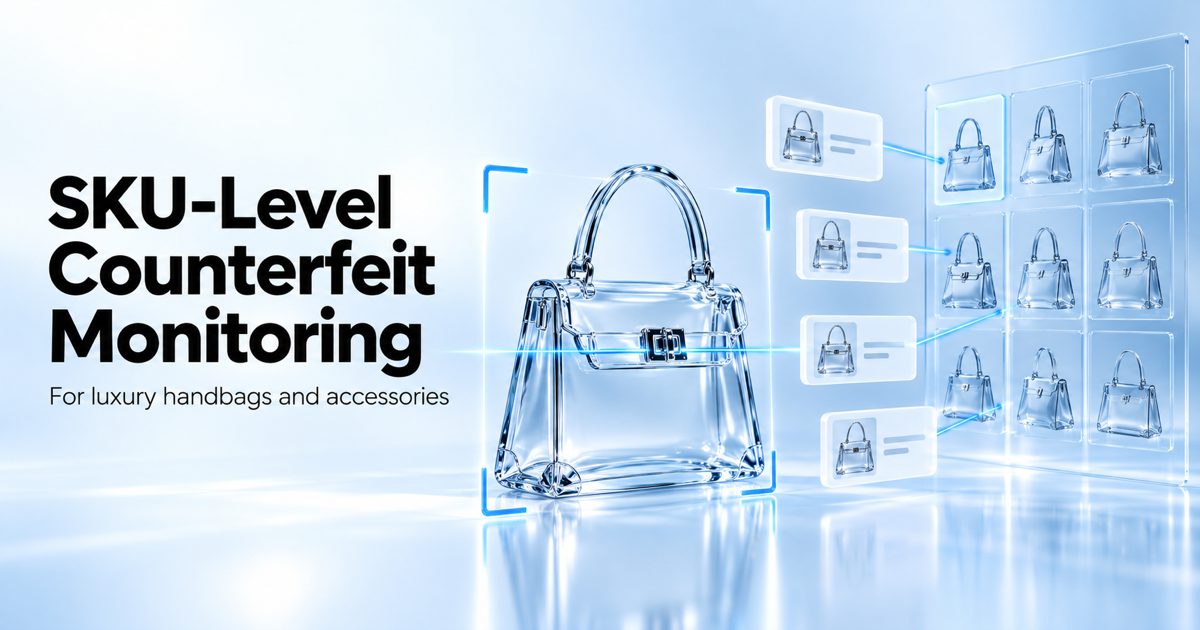
The fix isn’t a better keyword list, it’s matching against the wrong thing entirely if the check is still built around what the listing says rather than what it shows. SKU-level matching flips that: instead of asking “does this listing mention our brand,” it asks “does this listing’s image, price and seller pattern match a real SKU in our catalogue, or something close enough to one that it’s clearly meant to pass as it.” Truviss’s glossary entry on SKU-level matching covers the general mechanism; this is what it looks like applied to a handbag or accessory catalogue specifically.
Setting this up starts with the brand’s own catalogue, which is why product configuration matters as much as the scanning itself. Truviss’s brand catalogue and SKU configuration is what a detection pass is actually checked against, real SKUs, real images, real pricing bands, rather than a generic “fashion item” template that would flag a genuinely different handbag style as a false positive or, worse, miss a close copy because it technically isn’t identical.
Once that catalogue exists, a listing can be scored against it directly: does the image match this SKU’s hardware and proportions closely enough to be a copy, is the price meaningfully below the genuine line for a “new” item from an unverified seller, does the seller’s history show the bulk-listing pattern typical of a counterfeit operation rather than an individual reseller. None of those checks depend on the listing naming the brand at all.
Where these fakes actually surface
Marketplaces are the obvious channel, and they’re still the biggest one: unauthorised resellers undercutting the genuine product on price while looking close enough to pass a casual check. But accessory and handbag fakes increasingly move through a second channel that keyword-based tools rarely reach at all: social commerce fraud. Listings and short-form video showcases on social platforms, often followed by a direct message to close the sale, rely entirely on the buyer trusting what they see rather than searching a marketplace listing by name. That’s precisely the sales pattern SKU-level, image-first matching is built to catch, and precisely the pattern a text-only scanner walks straight past, because there’s often no searchable listing text at all.
A brand monitoring only its marketplace footprint is covering the channel that’s easiest to scan, not necessarily the one doing the most damage to a handbag or accessory line specifically.

How Truviss applies this to handbags and accessories
Truviss scans 500+ data points per listing (image, pricing, seller history, text and metadata) and matches what it finds at SKU level against the brand’s real catalogue, across both the Marketplace Scanner’s 150+ covered marketplaces and the Social Media Monitor’s coverage of Facebook, Instagram, X, TikTok and YouTube, the two channels that matter most for handbags and accessories specifically. Verified matches route to automated takedown, with human review available for the genuinely ambiguous cases, and every action is logged with the metadata and visual evidence needed for legal follow-up.
See how Truviss matches listings against your real SKU catalogue across marketplaces and social platforms.
Explore Marketplace ScannerThe closest documented precedent for this approach in practice is Truviss’s work with an Indian helmet manufacturer, a different high-value physical-goods category, not handbags, but the same underlying problem: counterfeit helmets relisted under authentic product names, undercutting genuine listings by 30-40%, with repeat offenders reappearing after being reported. The approach that worked there, daily scanning for overlapping SKUs and pricing anomalies, computer-vision cross-verification of product images against the brand’s own image library, and seller-identity analysis to map the unauthorised reseller network, is the same structural approach that applies to a handbag or accessory catalogue. The category is different; the mechanism (catalogue-level image and SKU matching, not keyword search) is not.
What to check before you assume you’re covered
If a handbag or accessory brand already has some form of brand protection in place, the honest question is what it’s actually checking. Does it match listings against the real catalogue at SKU level, or only against the brand name appearing in the text? Does its coverage extend to social resale and DM-driven sales, or only to marketplace listings with a searchable title? A tool that answers “keyword” and “marketplace only” to those two questions is covering the counterfeit activity that’s easiest to find, not necessarily the activity draining the most sales from a handbag or accessory line specifically. Closing that gap starts with catalogue-level configuration, not a longer list of banned keywords.
The same SKU-level logic applies well beyond luxury goods — supplement and vitamin brands face an almost identical counterfeit risk pattern.
Comments
One response to “Luxury Goods Brands: Why Handbags Need SKU-Level Monitoring”
[…] Luxury accessory brands were among the first to prove this approach works at scale — see how handbag brands use SKU-level monitoring. […]