Truviss’s Marketplace Scanner checks 500+ data points per listing across 150+ marketplaces, so counterfeit supplements get caught before they reach a customer, not after.
Book a demo
- A counterfeit supplement reaching a real customer is a product-liability and regulatory exposure for the real brand, not just a lost sale.
- Supplements get lighter pre-market regulatory scrutiny than pharmaceuticals, which shifts safety responsibility onto the brand, exactly where counterfeiters exploit the gap.
- Unlike a fake handbag, a fake capsule is consumed before anyone can inspect it, so detection has to work at the listing and seller level, not the finished product.
- Periodic manual audits structurally can’t keep pace with fast relisting; continuous, SKU-level monitoring across marketplaces and quick commerce closes that gap.
A customer buys a bottle of your multivitamin from a marketplace listing carrying your brand name. She takes it as directed. A week later she’s in an emergency room with a reaction nobody can immediately explain, and when the investigation starts, the bottle in her cupboard is the first thing anyone asks about.
It isn’t yours. It was made by nobody your quality team has ever heard of, packed to look exactly like your product, and sold under your listing by a seller you didn’t authorise. But your name is on the label, and that’s the name that ends up in the complaint, the regulator’s enquiry, and possibly the lawsuit.
This is the part of counterfeiting that a “lost sales” framing misses entirely. For a supplement or vitamin brand, a fake isn’t just a competitor undercutting your price. It’s a product with your name on it that you had no hand in making, dosing, or testing, now sitting inside a customer’s body. That’s a compliance and liability problem first. The revenue loss is almost an afterthought by comparison.
The regulatory gap counterfeiters are exploiting
Supplements don’t get the same pre-market scrutiny as pharmaceuticals. In the US, the FDA doesn’t approve a dietary supplement before it goes on sale. Under the Dietary Supplement Health and Education Act, the responsibility for making sure the product is safe sits with the brand, not with a regulator checking it first. That’s workable when the “brand” making the product is actually you. It stops being workable the moment a counterfeiter is selling under your name and inherits none of the accountability that comes with it, while you inherit all of the fallout.
That fallout has a specific shape. The FDA runs an active enforcement effort against supplements found to contain undeclared ingredients, most often in weight-loss, sexual-health, and bodybuilding-adjacent products, where a hidden active ingredient can turn a “harmless” capsule into something genuinely dangerous. This is dosage fraud and ingredient fraud, and it’s distinct from ordinary trademark counterfeiting: the harm isn’t just that the label is fake, it’s that the customer has no idea what they actually ingested.
This isn’t hypothetical for supplement brands. In one documented case, NOW Foods found 11 different counterfeit versions of its own products, including a men’s multivitamin and magnesium citrate, sold by a single Amazon seller. When NOW tested the capsules, some contained nothing but rice flour; others showed trace amounts of the prescription drug sildenafil, undeclared on any label. Separately, Fungi Perfecti discovered unauthorised sellers passing off imitation Host Defense mushroom products, some later confirmed to contain soy and gluten despite the genuine line being free of both, and won a court judgment and permanent injunction against one of those sellers. Neither brand found out through a customer complaint reaching them first; they had to go looking. If your legal or compliance team’s only evidence trail is whatever a customer happens to report, you’re finding out about the exposure after the harm has already happened, not before.
Why a fake vitamin is harder to catch than a fake handbag
Most counterfeit detection assumes someone, somewhere, gets a close look at the product before or after it changes hands. A counterfeit handbag can be inspected by a buyer, flagged in a review, or physically compared against the real thing. A counterfeit capsule doesn’t get that chance. It’s opened, swallowed, and gone, long before anyone would have the opportunity to notice the stitching was wrong, because there is no stitching. There’s a pill, a capsule, or a powder that looks identical to the real thing right up until it’s consumed.
That means the entire “tell” of a supplement counterfeit lives in the packaging, the seal, the label, and the listing itself, not in the product a customer could return for inspection. By the time a customer notices something’s off, whether that’s no effect at all or an actual adverse reaction, the physical evidence is usually already gone. What’s left is the counterfeit listing itself: who sold it, at what price, with what images, under what seller history.
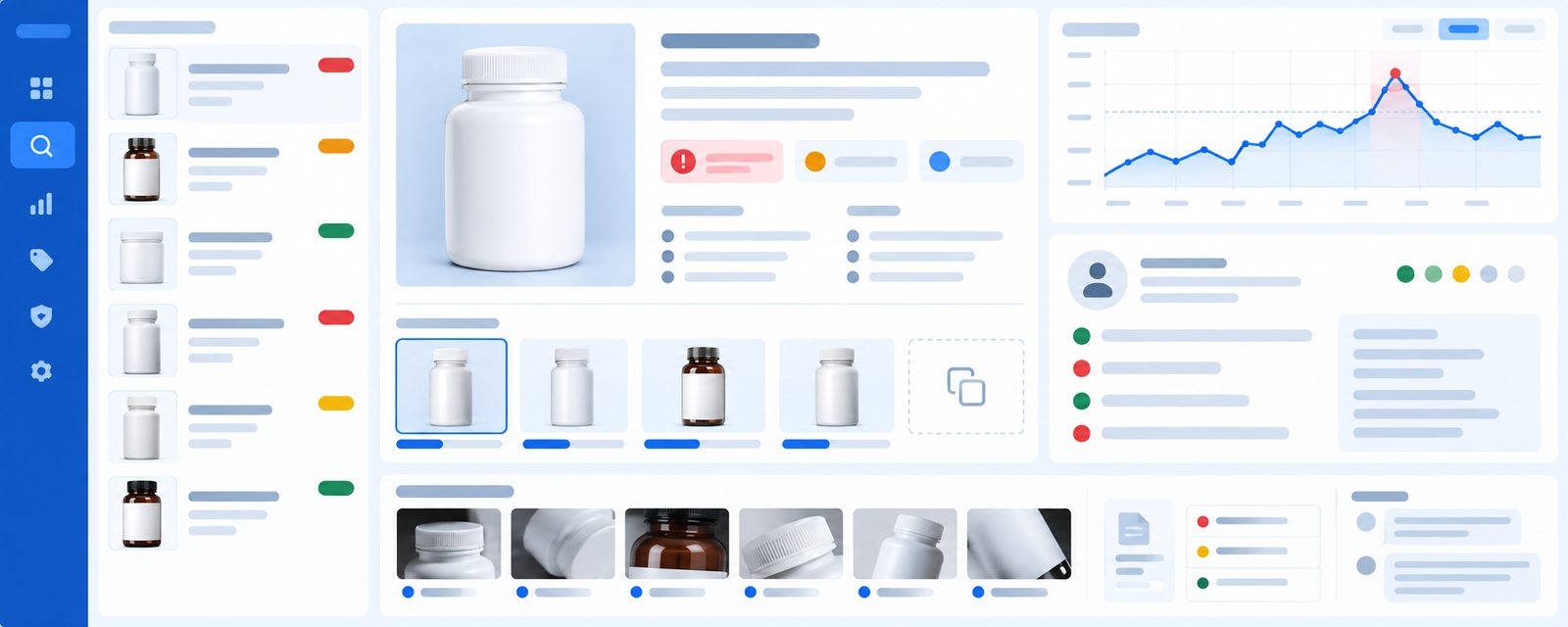
That’s exactly why detection for this category has to work at the level of the listing and the seller, not just the finished product. Matching a listing’s images, pricing pattern, seller history, and text against a brand’s real catalogue at SKU-level precision is what catches a supplement counterfeit while the listing still exists, which is the only window where catching it actually helps anyone.
See how Truviss’s Marketplace Scanner checks 500+ data points per listing, exactly what a category that can’t be inspected after purchase needs.
Explore Marketplace Scanner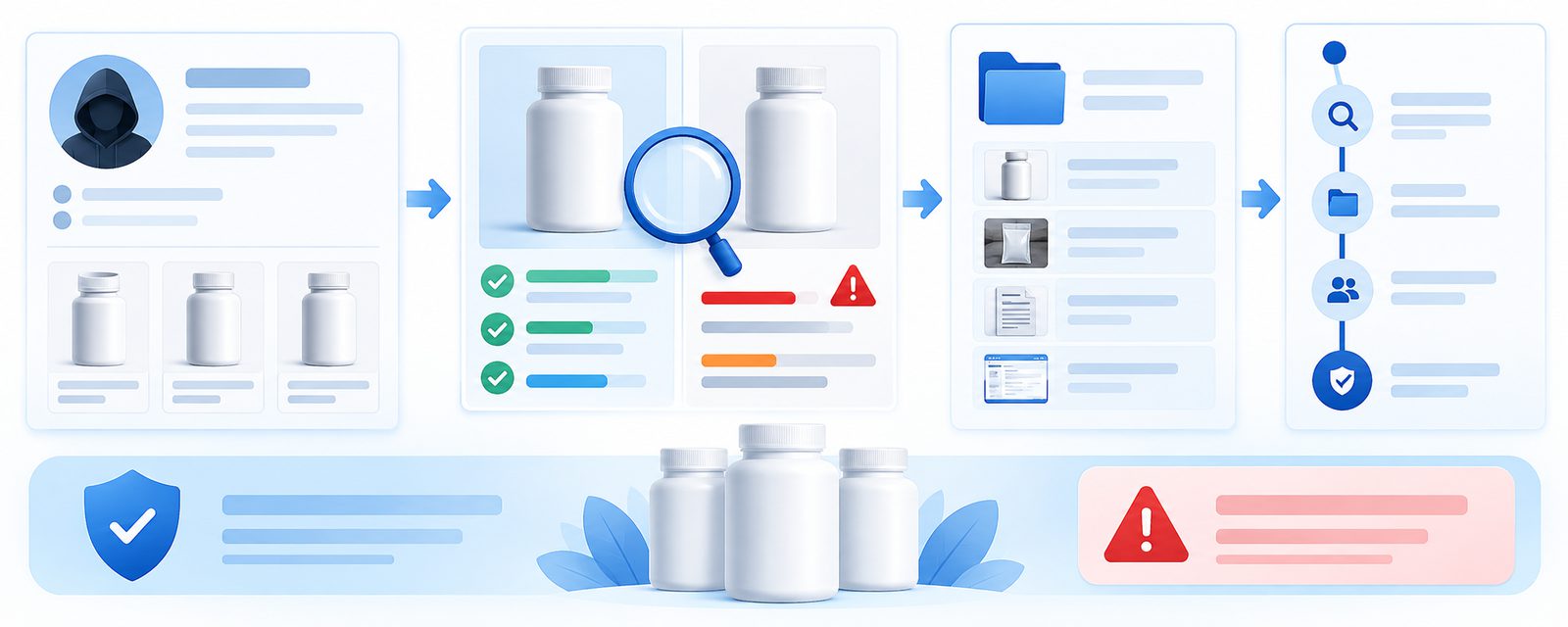
Where these fakes actually surface
Supplement counterfeits don’t need an obscure corner of the internet. They show up on the same mainstream marketplaces where your genuine listings already live. One documented mechanism is commingled inventory, where a marketplace pools stock from multiple sellers claiming to sell the same product into a single warehouse bin, so a customer ordering directly from a trusted brand’s listing can still receive a unit shipped by an entirely different, unauthorised seller. Amazon has announced it will end this commingling practice by March 2026 specifically to curb counterfeits reaching customers this way, which confirms the risk rather than resolving it retroactively: it was live and documented long enough to need a policy change.
Quick commerce is the newer version of the same problem, and arguably a faster-moving one. Rapid-delivery apps move fast-turnover categories like supplements and personal care with a fraction of the seller and catalogue vetting a mainstream marketplace applies, and inventory turns over in days rather than weeks. That combination, thin vetting plus fast turnover, is exactly the environment counterfeiters relist into after being caught once. In India specifically, where supplements already move through gyms, small retail, and marketplaces with inconsistent seller checks, this channel mix compounds the exposure rather than replacing it.
Why a quarterly audit can’t keep up with any of this
A manual review of marketplace listings, run monthly or quarterly, will genuinely catch things. It will also always be catching yesterday’s problem. A counterfeit seller found and reported today can relist under a new seller ID within days, sometimes faster than that, and a periodic sweep by definition only looks at the moment it happens to run. Every day between sweeps is a day a new listing could be live, unflagged, and being fulfilled to real customers.
Truviss has seen this pattern play out directly with a helmet manufacturer client: repeat offenders relisted after being reported, faster than a periodic check could catch them again, until continuous, daily marketplace monitoring closed that gap. The same dynamic applies to supplements, with a sharper edge, because the product being relisted is something a customer will actually consume. Continuous surveillance, watching marketplaces and quick-commerce channels around the clock rather than at scheduled intervals, catches a new listing the day it appears. For a category where harm can happen inside the gap between one audit and the next, that difference in cadence isn’t a nice-to-have. It’s the entire point.
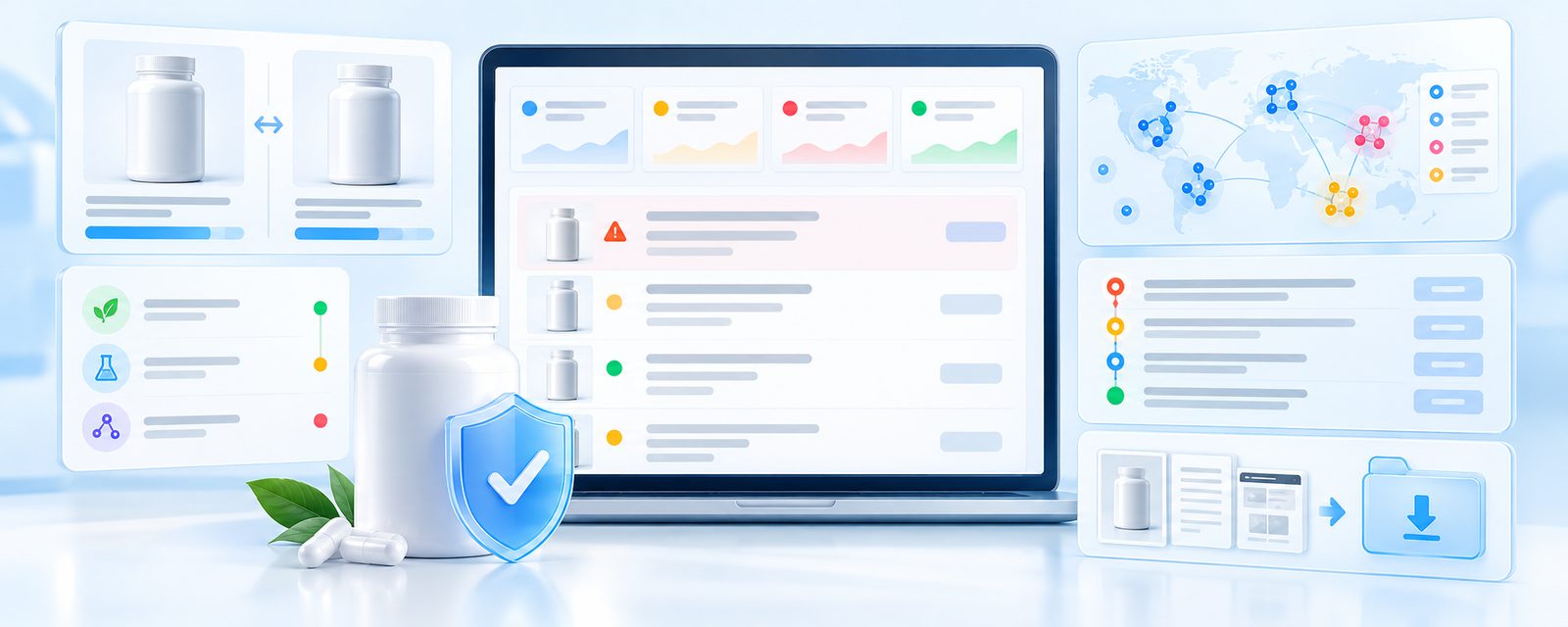
There’s also the paper trail question. If a regulator or a customer’s legal counsel ever asks what your brand was doing to monitor for counterfeit versions of your product, “we checked a few times a year” is a materially weaker answer than a documented, continuous record of every threat detected, verified, and acted on, with evidence attached. Case management and audit-trail evidence storage aren’t just useful for the takedown itself. They’re what turns “we didn’t know” into “here’s exactly what we knew, and when.”
The real question isn’t whether you’re losing sales
For a brand manager or e-commerce lead in this category, the useful question isn’t “how many sales are counterfeiters costing us.” It’s “if we’re asked to prove we were watching, can we.” A fake protein tub or a fake multivitamin is a live product safety question the moment it reaches a customer’s hands, and the brand whose name is on the label carries that exposure whether or not it made the product inside.
Continuous, SKU-level monitoring across marketplaces and quick commerce won’t stop every counterfeiter from trying. It does mean the gap between a fake listing appearing and someone at your brand knowing about it shrinks from months to hours, which is the only version of this that actually matters for a product people put in their bodies. If your current process is a periodic check rather than a continuous one, that gap is where the real risk sits. See how Truviss’s Marketplace Scanner catches counterfeit listings across 150+ marketplaces, or book a demo to see continuous monitoring against your own catalogue.
Luxury accessory brands were among the first to prove this approach works at scale — see how handbag brands use SKU-level monitoring.
Comments
One response to “Supplement & Vitamin Brands: The Counterfeit Risk Your Marketplace Scanner Should Catch”
[…] The same SKU-level logic applies well beyond luxury goods — supplement and vitamin brands face an almost identical counterfeit risk pattern. […]