Truviss

Tag: IP Infringement

  • Fake Trademark Deeds Now Hijack Marketplace Listings

    Fake Trademark Deeds Now Hijack Marketplace Listings

    Home/Blog/Fake Trademark Deeds Now Hijack Marketplace Listings
    Marketplace Protection

    Fake Trademark Deeds Now Hijack Marketplace Listings

    Watch who controls your listings

    Truviss’s Marketplace Scanner tracks Buy Box and seller-identity changes on your own listings, catching an ownership hijack before it costs you your reviews and sales history.

    Book a demo
    Fake Trademark Deeds Now Hijack Marketplace Listings cover
    TL;DR
    • Counterfeiters are forging trademark registration certificates and assignment deeds to convince marketplaces they own a brand, then taking over the real seller’s listing.
    • Standard counterfeit-detection tooling (image, price, duplicate-listing checks) doesn’t catch this: the product and price stay the same, only who controls the listing changes.
    • The fix is monitoring listing ownership and seller-identity changes directly, not adding another layer of counterfeit-image detection.
    • Speed matters once it happens: reviews and sales history built over years keep accruing to the hijacker until the listing is reclaimed.

    A seller on Amazon spends years building a listing: real product, real reviews, real sales rank. Then one day the Buy Box quietly changes hands. Not because a shopper preferred someone else’s price. Because someone else submitted a trademark assignment deed claiming they, not the original seller, own the brand behind that listing, and the marketplace’s verification process accepted it.

    This is happening on marketplaces right now, and it isn’t a counterfeit-detection problem in the sense most brand-protection advice assumes. It’s a document-fraud problem aimed squarely at the marketplace’s own trust process, and it’s catching sellers who did everything else right.

    How the forgery actually works

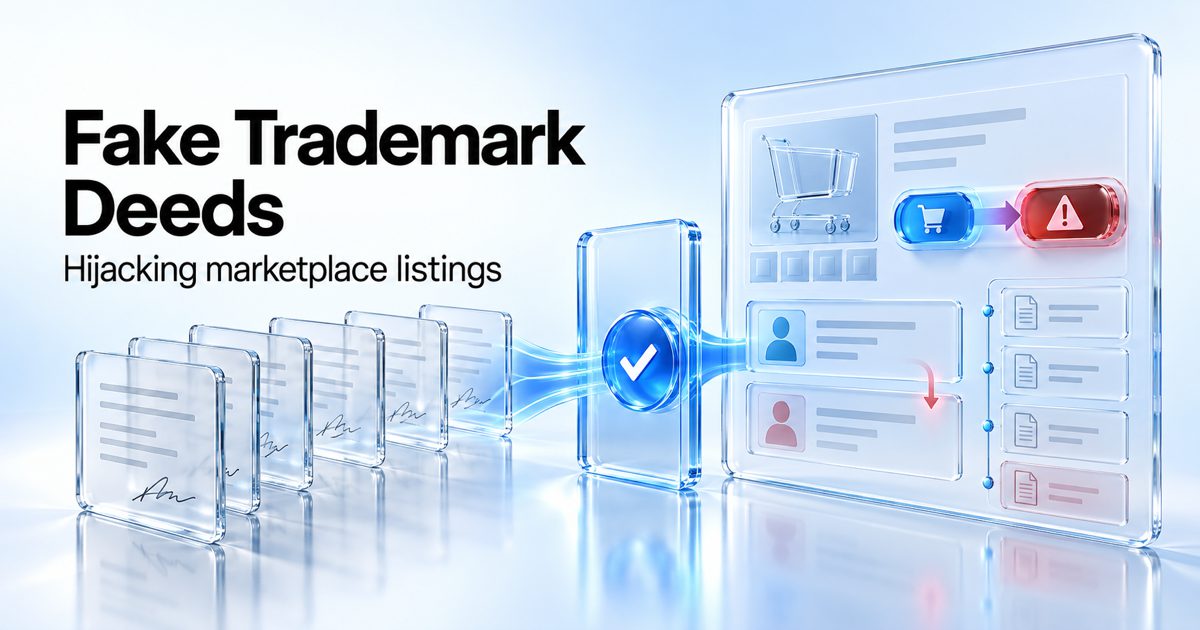
    Counterfeiters used to need a convincing fake product. Increasingly, they don’t bother faking the product at all, they fake the paperwork that proves who owns the brand behind it. Business Standard’s reporting on this (15 July 2026, “Fake signatures, fake lawyers: Counterfeiters outsmart online marketplaces”) documented forged trademark registration certificates, fabricated assignment deeds, and fake legal letterhead submitted to convince a marketplace that the submitter, not the actual brand owner, holds the rights.

    Once that claim is accepted, the marketplace treats the forger as the legitimate rights-holder. That’s the part that makes this different from a normal counterfeit listing: the marketplace isn’t being fooled by a bad product, it’s being fooled by paperwork that looks exactly like the real documentation it’s designed to accept. A trademark certificate is a trademark certificate to an automated verification queue processing thousands of submissions; it doesn’t inherently know that this particular one is fabricated. From there, the forger can attach their own offer to the real seller’s existing listing (a Buy Box takeover, riding on reviews and sales history they never earned) or, in more aggressive cases, file a false infringement complaint against the real seller using the fabricated ownership claim, getting the genuine listing suspended entirely.

    Why standard counterfeit-detection tooling misses this

    The existing brand-protection playbook, and every major vendor’s published guide to it, is built around one assumption: the brand owner is the one filing evidence to get someone else’s bad listing removed. Red Points, BrandShield, Corsearch and mFilterIt all publish detailed guides on exactly that process: identify the infringement type, gather proof of ownership, submit it to the platform, wait for a response. All of it assumes your ownership status isn’t in dispute.

    None of it covers the inverted case: a brand owner losing control of their own listing because somebody else’s forged paperwork got accepted first. If your detection tooling is watching for counterfeit images, suspicious pricing, or duplicate listings, none of those signals fire here. The product photos are real. The price is normal. The listing itself hasn’t changed at all except who controls it. This is a gap in what “counterfeit detection” usually means, not a failure of any one vendor’s execution of it.

    What actually catches it: watching who controls the listing, not just what’s on it

    If the attack targets ownership and identity rather than product or price, the defence has to watch the same thing: who controls a listing, and when that control changes. That means monitoring Buy Box reassignment on your own listings, tracking seller-identity changes behind a product page that previously belonged to you, and treating an unexplained ownership or seller-ID shift as a signal worth investigating immediately, not something that surfaces weeks later in a routine audit.

    This is a different job from scanning marketplaces for lookalike products or counterfeit images, and it’s the specific gap Truviss’s Marketplace Scanner is built to close: continuous marketplace monitoring of listing and seller-identity signals, not a one-time image sweep. A related but distinct problem worth knowing about too: AI-generated fake product listings built from synthetic photos rather than forged paperwork, covered separately since the mechanism and the fix both differ from what’s described here.

    See how Truviss’s Marketplace Scanner tracks Buy Box and seller-identity changes on your own listings.

    Explore Marketplace Scanner

    What to do if it’s already happened

    Speed matters more than thoroughness here, because every day the hijack goes unresolved, the reviews and sales history a legitimate seller built over years keep accruing to someone who took the listing by forging a document, not by earning it.

    Gather what actually proves prior ownership: the original trademark registration in your name, dated records of when you first listed the product, and the specific date the Buy Box or listing control changed hands. Escalate directly to the marketplace’s brand-registry or IP-enforcement team rather than a general seller-support queue; general support often isn’t equipped to adjudicate a competing ownership claim and will default to whichever document was submitted first. If the marketplace’s takedown process stalls because it’s treating this as a dispute between two rights-holders rather than a fraud case, be explicit that the submitted documents are forged, not merely contested, and provide whatever evidence supports that (verifiable trademark office records, for instance) as directly as possible.

    The uncomfortable part of this is that the marketplace’s own verification step, the thing meant to protect legitimate sellers, is the exact mechanism being exploited. That’s not a reason to stop relying on platform enforcement, but it is a reason not to treat “the marketplace verifies ownership” as a defence on its own. It’s a defence that fails silently, and the only reliable way to catch that failure is watching your own listings for exactly the kind of ownership change that shouldn’t be able to happen without your knowledge.

  • Protecting Intellectual Property in E-commerce: The Complete Guide (2026)

    Protecting Intellectual Property in E-commerce: The Complete Guide (2026)

    Home/Blog/Protecting Intellectual Property in E-commerce: The Complete Guide (2026)
    Marketplace Protection

    Protecting Intellectual Property in E-commerce: The Complete Guide (2026)

    Protecting Intellectual Property in E-commerce cover
    TL;DR
    • Counterfeit goods made up an estimated USD 467 billion in global trade in 2021, 2.3% of world trade, and e-commerce has made it easier for fakes to reach buyers directly.
    • The most common IP threats in e-commerce are counterfeit listings, unauthorised resellers, and image/content theft on marketplace pages.
    • Manual reporting to marketplaces one listing at a time cannot keep pace with how quickly new fakes appear.
    • A documented, evidence-backed process (detect, verify, enforce) protects both revenue and any future legal action.

    What intellectual property infringement looks like in e-commerce

    For most brands selling online, intellectual property infringement isn’t a single dramatic event, it’s a slow accumulation of smaller ones. A counterfeit listing undercutting price on a major marketplace. Product photography lifted directly from a brand’s own site and used to sell a fake. A reseller account with no real authorisation trading on a brand’s name to look legitimate. Each of these is a form of online brand protection failure, and each one chips away at revenue and customer trust in a way that’s easy to miss until it’s already widespread.

    Global trade in counterfeit goods reached an estimated USD 467 billion in 2021, equivalent to 2.3% of total world trade, and EU imports of fakes alone were valued at EUR 99 billion, or 4.7% of the EU’s imports from outside the bloc (OECD/EUIPO, Mapping Global Trade in Fakes 2025). E-commerce is a large part of why: a counterfeit seller no longer needs a physical storefront or a distribution network, just a marketplace account and a product photo to copy.

    Why marketplaces are a particular risk

    Marketplaces solve a genuine problem for brands, reach and distribution without owning the infrastructure, but that same openness is what counterfeit sellers exploit. Clothing, footwear and leather goods jointly accounted for 62% of all counterfeit goods seized globally (OECD/EUIPO, Mapping Global Trade in Fakes 2025), categories that also happen to be some of the most heavily traded on consumer marketplaces. A fake listing doesn’t need to fool everyone, it only needs to look convincing enough at the moment of purchase, and a lower price than the genuine product is often all the nudge a buyer needs.

    The problem compounds because a single successful fake listing tends to attract copies. Once one seller demonstrates a counterfeit can stay live long enough to generate sales, others list the same product, and a brand can find itself facing a dozen near-identical infringing listings instead of one.

    The real cost of unprotected IP online

    The direct cost is lost sales, a customer who buys the fake was never going to buy the genuine product at that moment. But the larger cost is usually indirect. A customer who receives a counterfeit product and doesn’t realise it’s fake will often leave a negative review against what they believe is the real seller, damaging star ratings and search ranking that the genuine brand worked to build. Paid search and marketplace advertising can also end up funding the problem: ad clicks convert on whichever listing ranks best at that moment, and a well-optimised fake can quietly absorb ad spend meant for the real product.

    None of this shows up cleanly in a standard sales or marketing report. It requires actively looking for it.

    Manual enforcement versus continuous monitoring

    Most brands start IP enforcement the way they start most operational problems: manually. Someone on the team periodically searches marketplaces for obvious fakes and files a report through the platform’s own process. This works, up to a point. It catches the most blatant infringements and it costs nothing beyond time.

    Where it breaks down is scale and speed. A new counterfeit listing can go live and start generating sales within hours, long before a periodic manual search would find it. Multiply that across every marketplace, region and product line a brand sells, and manual searching simply cannot keep pace with how quickly new listings appear. Continuous, automated monitoring exists to close that gap, not by replacing human judgement, but by surfacing candidates for review the moment they appear rather than weeks later.

    Building a takedown process that holds up

    A durable enforcement process generally follows three stages:

    Detect continuously, not periodically. Scanning that runs 24/7 across the marketplaces and channels where a brand actually sells, matched against real product images, pricing and seller history rather than keyword search alone.

    Verify against the brand’s actual catalogue. This is the step that protects genuine resellers and authorised partners from being mistakenly caught up in enforcement, and it’s also what gives a takedown request credibility with the platform reviewing it.

    Enforce with a documented trail. Every detected listing and every enforcement action should be logged, not just for the immediate takedown, but as evidence if a case ever escalates beyond a single platform’s own process.

    See how Truviss runs this detect, verify, enforce cycle across marketplaces automatically.

    Explore Marketplace Scanner

    Common mistakes brands make

    The most common mistake is treating IP protection as a one-off clean-up rather than an ongoing process. A brand runs a sweep, removes the listings it finds, and moves on, only for a fresh batch of counterfeit listings to appear within weeks because nothing is actively watching afterward.

    A close second is inconsistent evidence. Reporting a listing without documenting when it was found, what made it identifiable as counterfeit, and what happened after the report was filed makes it much harder to demonstrate a pattern if a case needs to go further than a single marketplace’s internal process.

    A third is assuming marketplace reporting tools alone are enough. They’re built for occasional individual reports, not for identifying every new instance of a repeat-offending seller across multiple listings and storefronts.

    Getting started

    Start with whichever channel carries the biggest exposure. For most consumer brands selling through third-party marketplaces, that’s counterfeit listings; for others it may be typosquatted domains or impersonator accounts. Get continuous monitoring in place on that one channel first, build a documented takedown process around it, then expand coverage as the process proves itself.

    Frequently asked questions

    How do I know if my products are being counterfeited online?

    Search your brand name and product names on the marketplaces you sell through, and check for prices significantly below your own. Manual searching will catch the most obvious cases; continuous monitoring is what catches new listings as they appear rather than after they’ve been live for weeks.

    Can I take action against a counterfeit seller directly, or only report to the marketplace?

    Marketplace takedown requests are usually the fastest route since the platform can remove the listing directly. Legal action against the seller is a separate, slower process, and having a documented evidence trail from marketplace monitoring makes that route far more workable if it’s ever needed.

    Will monitoring flag my own authorised resellers as infringers by mistake?

    It shouldn’t, provided detection is verified against your actual product catalogue and known authorised sellers rather than triggered on keywords alone. This is why the verify step matters as much as detection itself.

    How quickly can a counterfeit listing typically be removed?

    This varies by marketplace and by how well-documented the takedown request is. A verified infringement with clear evidence is generally actioned faster than a vague report, which is why keeping a consistent evidence trail matters even for routine takedowns.

    Is this only a concern for large, well-known brands?

    No. Smaller and mid-sized brands are targeted too, and often have fewer resources for manual monitoring, which makes an automated process more valuable relative to the size of the team available to run it.

    What’s the difference between a counterfeit listing and an unauthorised reseller?

    A counterfeit listing sells a fake product. An unauthorised reseller sells the genuine product outside the brand’s approved sales channels, which is a different (usually contractual, not IP) issue and typically requires a different response.