Takedown Request Templates: Copy-Paste Notices for 5 Targets

- A takedown request can fail even when your rights are strong, simply because the wording is vague.
- Every request needs six things: who you are, your right, the exact target, why it infringes, what you want and an accuracy statement.
- This guide gives ready-to-use templates for a marketplace listing, website host, domain registrar, social post and app store listing.
- Send one request per target, with dated evidence attached, and keep the tone factual.
What every takedown request must contain
Whatever the recipient, a request that gets acted on answers six questions.| Element | What to write |
|---|---|
| Who you are | Company name, your role, a contact email that is monitored |
| Your right | Trademark name, registration number, country, class. Copyright owners give the original work and where it was first published |
| The exact target | The full URL, listing ID (ASIN, Flipkart product ID or equivalent), account handle or app package name. One target per request |
| Why it infringes | One or two factual sentences: what it shows, what it sells, how it uses your mark |
| What you want | Removal, suspension or disablement, stated plainly |
| Accuracy statement | That the information is accurate and the use is not authorised by you or the law |
Build the evidence pack before you write
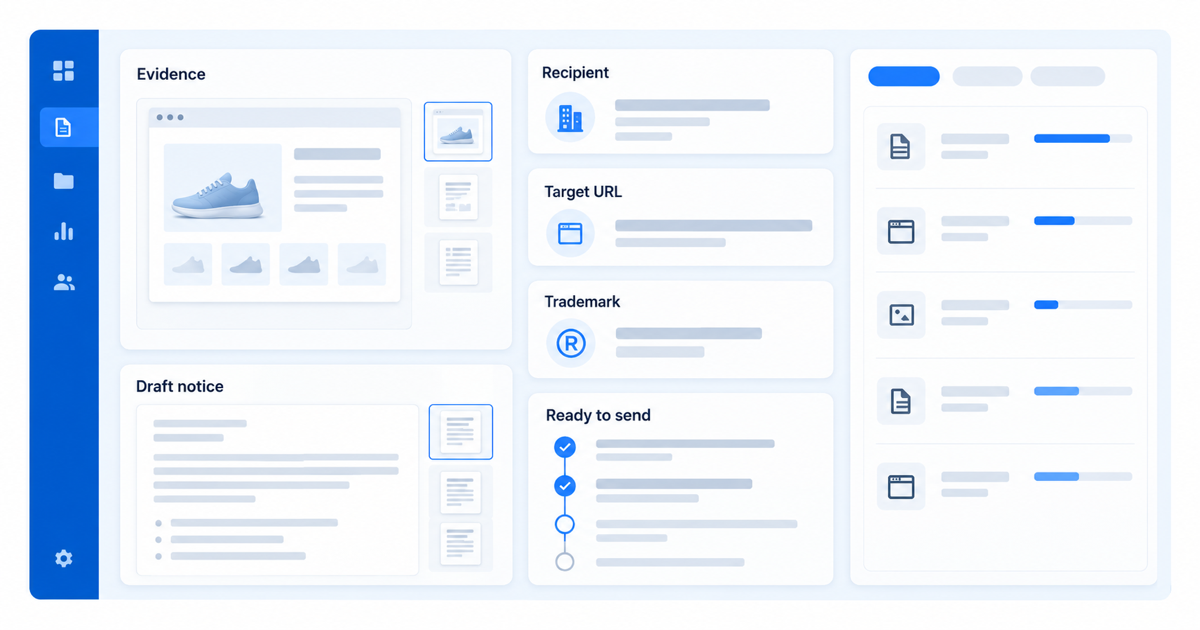
Capture these before you send anything, because listings and accounts change or disappear once the seller is alerted.- Dated full-page screenshots of the listing, the seller storefront and any seller contact details
- The listing URL and ID, the seller name or ID, and the date and time you captured them
- Your trademark registration certificate or the registry record, and proof of ownership for any copied images or text
- Your authentic product details to compare against: SKU, packaging, batch codes, pricing
- A test purchase where the platform and the case justify it, with the order record and unboxing photos
Template 1: marketplace listing
Use this in the platform’s own intellectual property or trademark complaint form (Amazon and Flipkart document one, and most other large marketplaces have an equivalent; check each platform’s current page for the exact name). Paste it into the description field and fill the structured fields the form asks for separately. For the click path on each platform, see how to report counterfeit sellers on Amazon, Flipkart and Alibaba.I am [name], [role] at [company], the owner of the registered trademark [MARK] ([registration number], [country], class [number]). The listing [URL / listing ID] sold by [seller name or ID] offers goods under our mark that we did not manufacture and have not authorised. [One factual line: for example, the product shows our registered logo and a pack design we do not use, at a price well below our authorised retail price.] Dated screenshots and the registration record are attached. I request that the listing be removed. I confirm that the information in this notice is accurate and that the use of the mark is not authorised by me, my company or the law. Contact: [email].One listing per notice. If a seller has twenty listings, send twenty IDs only where the form explicitly allows a list; otherwise file separately.
Template 2: website or hosting provider
Find the host’s abuse contact first; how to take down a copycat website shows how. If your claim is copyright rather than trademark, use the structure in our DMCA notice steps instead.Subject: Trademark infringement and impersonation: [domain] To the abuse team at [host], I am [name] at [company], owner of the registered trademark [MARK] ([registration number], [country]). The website at [full URL] hosted on your network [IP / hosting details if known] uses our mark and [copies our product images / presents itself as our official store]. We have not authorised this. Evidence is attached: dated screenshots, the registration record and our official domain for comparison ([official domain]). Please disable the site or remove the infringing content and confirm the action taken. I confirm the information above is accurate. Contact: [email].
Template 3: domain registrar
Registrars tend to act where there is a clear trademark claim or a phishing or fraud use, so be short and specific about which applies. The mechanics of lookalike domains are in our domain phishing guide.Subject: Domain abuse report: [domain] I am [name] at [company], owner of the registered trademark [MARK] ([registration number], [country]). The domain [domain], registered through you, is confusingly similar to our mark and our official domain [official domain]. The domain is used for [selling goods under our mark / collecting login or payment details / presenting itself as our company]. Screenshots with capture dates and the registration record are attached. I request that you investigate and suspend the domain under your abuse policy. I confirm the information above is accurate. Contact: [email].State the use you can show, not the use you suspect. A registrar can act on “the page asks customers for card details under our name” faster than on “the domain looks suspicious”.
Template 4: social media post or account
Use the platform’s impersonation or trademark report form and put this in the description. Report the account and individual posts separately if both are infringing.I am [name] at [company], owner of the registered trademark [MARK] ([registration number], [country]). The [account / post] at [URL] uses our name, logo and product images to [sell goods / run giveaways / contact customers] as if it were us. It is not operated by us or anyone we have authorised. Screenshots and our official account link ([official URL]) are attached. I request removal of the [account / post]. I confirm the information in this report is accurate. Contact: [email].
Template 5: app store listing
Use the store’s developer content or trademark complaint route. Name the exact app and say how it copies you.I am [name] at [company], owner of the registered trademark [MARK] ([registration number], [country]). The app [app name] ([package name / app ID], developer [developer name]) uses our name and logo and presents itself as our official app. We have not authorised this developer. Store page screenshots, the app’s screens showing our branding, and our official app listing ([official URL]) are attached. I request that the app be removed from the store. I confirm the information above is accurate. Contact: [email].
Five wording mistakes that get a request returned
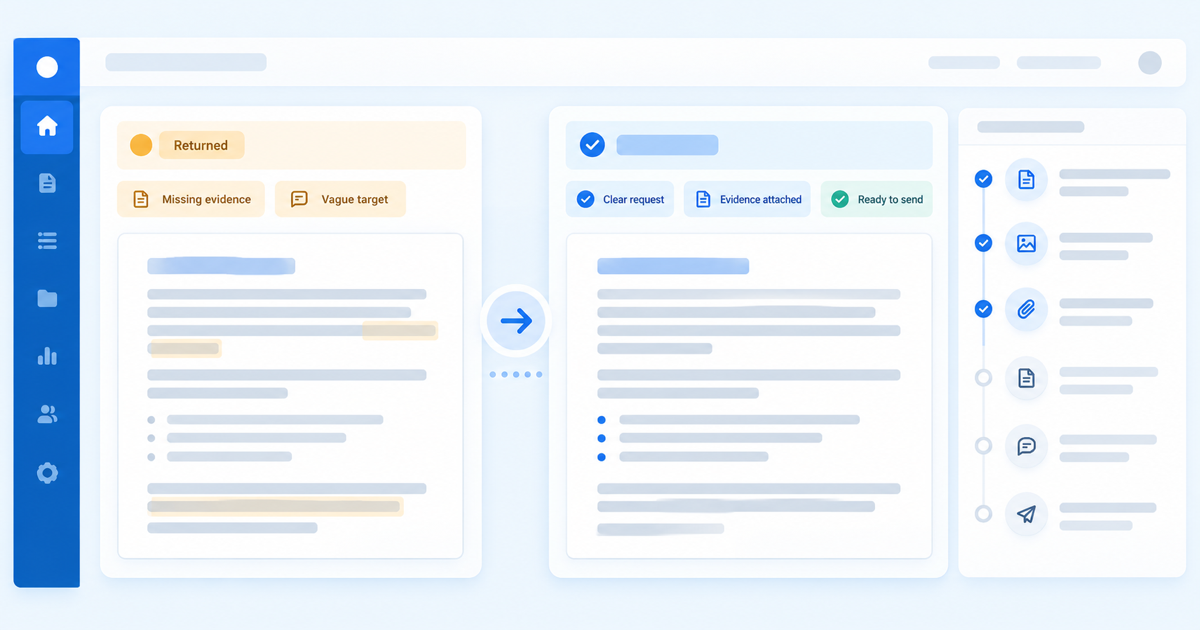
- “Fake” with no evidence. Say what you can show: logo, packaging, price, seller details.
- No listing ID or URL. A reviewer cannot act on “the seller on your site”.
- Missing registration number. Without it, many platforms treat the notice as incomplete.
- Threats in a platform form. Save legal language for a separate letter; the form reviewer only needs facts.
- Several targets in one notice. One target per request keeps one rejection from sinking the others.
When a template is not enough
Templates handle a case. They do not handle a pattern. If the same seller returns under new accounts, or you are filing dozens of requests a week, the work becomes detection and tracking, not drafting. That is where Truviss’s marketplace scanner and repeat-infringer tracking (Top Offenders) earn their place: the scanner finds the listings, and the case record gives you the evidence trail for the next request. For marketplace-specific removal support, see Amazon counterfeit listing removal. If you are not sure where to start, send us the listing, website, domain, social post or app you want removed through the form on our contact page and we will tell you which route fits.Frequently asked questions
What is a takedown request?
What is the difference between a takedown request and a DMCA notice?
Do I need a registered trademark?
Can I send one email to many targets?
What if the platform has no form?
Do I need a lawyer?
Mithileshkumar leads growth at Truviss, working every day to make sure the brands losing the most to counterfeits, fraud and digital impersonation are the ones who find out about a fix first. He’s spent his career believing that good marketing isn’t about noise, it’s about showing up right when someone needs the answer. Off the clock, he’s usually chasing the same instinct in something entirely unrelated to work.
More from Mithileshkumar R NaikRelated reading
Fake Google Ads for Your Brand: How to Spot and Report Them
How to spot fake Google ads that use your brand name, what evidence to capture and how to report them to Google and to the host o…
Brand Abuse Detection: Types, Examples and How to Spot It
The six main types of brand abuse, what each looks like, where it appears and how to detect it, with a weekly checklist and the r…
How to Take Down a Copycat Website: A Guide
A step-by-step guide to removing a copycat website: evidence, WHOIS lookup, hosting and registrar reports, DMCA, and when to esca…